Zomato
Preface: Why This Business Earns Study
Imagine urban India in 2030. A young professional in Bengaluru opens her phone at 8:47 PM and orders dinner, fresh groceries, and two cinema tickets all delivered or confirmed within fifteen minutes, all through a single platform. She does not think about the extraordinary logistics ballet this requires, any more than she thinks about the electrical grid when she flicks on a light. This seamlessness this invisibility is the ultimate aspiration of Eternal Limited, and it is the quality that makes the company worthy of disciplined analytical attention.
We approach this essay from the Buffett-Munger tradition of value investing: patient, first-principles, deeply skeptical of consensus, and relentlessly honest about uncertainty. Munger reminds us that the best way to understand a business is to try, earnestly, to destroy it to find the failure modes before the market does. This is Jacobi’s inversion maxim applied to equity analysis: invert, always invert. Rather than ask “why will Eternal succeed?”, we first ask “under what specific conditions would this investment permanently impair capital?” The answer to that question disciplines everything that follows.
At current prices of ₹230 per share (March 2026), the market is asking investors to pay 959 times trailing earnings and roughly 5 times trailing revenue for a business that earned its first full year of operating profitability only in FY24. That is either extraordinary insight about future earnings power, or extraordinary optimism. This essay attempts, with rigour and intellectual honesty, to determine which
Part I: The Business What Eternal Actually Does
Eternal Limited incorporated in 2010 as Foodiebay, renamed Zomato in 2010, and rebranded as Eternal in March 2025 is best understood not as a food delivery company, but as India’s emerging urban convenience platform. The renaming itself is philosophically significant: the founders are signalling that food delivery, however important, is merely the foundation of something larger. Eternal aims to become the default layer through which urban India consumes, discovers, and experiences the city.
Business Pillar 1: Zomato Food Delivery & Discovery
The food delivery platform connects over 800,000 restaurant partners with millions of consumers across 800+ Indian cities. It operates on a marketplace model collecting commissions from restaurants (typically 18–25% of order value) and delivery fees from consumers. Net Order Value (NOV) in food delivery grew 20% YoY in FY25. The company commands approximately 55–58% of the Indian food delivery market, making it the dominant player in a structural duopoly with Swiggy. This is the cash engine of the business, generating consistent operating cash flows that fund Blinkit’s expansion.
Business Pillar 2: Blinkit Quick Commerce
Blinkit, acquired from Grofers in 2022 for ₹4,447 crore, has become the crown jewel and primary value driver of Eternal’s portfolio. The platform delivers groceries, electronics, personal care products, and now even furniture and medicines in 10–30 minutes from a network of “dark stores” small, nonpublic warehouse facilities located within 2–3 km of highdensity residential clusters.
Blinkit’s transformation is striking. At acquisition, it was a struggling grocery delivery business. By December 2025, it operated 2,027 dark stores the largest network in India and commanded approximately 45% of the quick commerce market. Goldman Sachs independently valued Blinkit at $10.5–13 billion, six times what Eternal paid for it three years earlier. Quick commerce contributed 26% of Eternal’s FY25 revenue, rising to an estimated 60%+ of TTM revenue following the shift to an inventoryled model.
Business Pillar 3: Hyperpure B2B Restaurant Supply
Hyperpure is Eternal’s B2B food supply platform, sourcing fresh ingredients directly from farms and manufacturers and delivering them to restaurant partners. It serves as the supply chain backbone for both food delivery restaurants and, increasingly, Blinkit’s dark stores. While not a highmargin business, it deepens Eternal’s relationships with restaurant partners and reduces their dependency on traditional wholesale channels.
Business Pillar 4: District Going Out & Entertainment
District, launched via the acquisition of Paytm’s entertainment ticketing assets in FY25, combines diningout discovery, movie tickets, sports events, and live entertainment into a single app. It competes with BookMyShow in ticketing and with Dineout in restaurant reservations. The segment is earlystage and currently lossmaking, but management expects contributionpositive economics by FY27. The District app has been launched in the UAE as well, signalling international ambitions.
Part II: The Industry Secular Growth Vectors
Vector 1: India’s Urban Consumption Boom
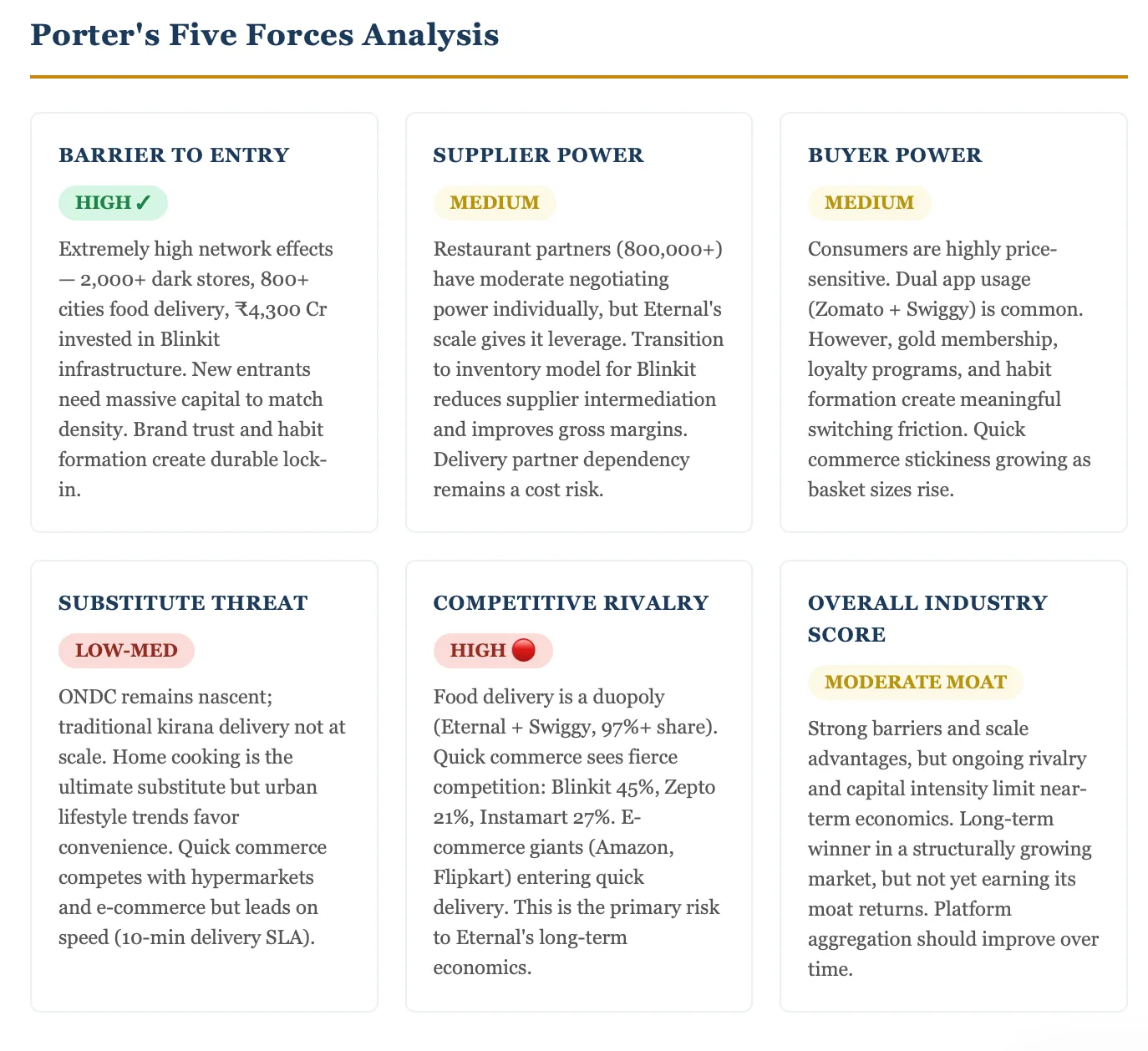
India’s urban population is expected to grow from 500 million today to over 600 million by 2030. This urbanisation is accompanied by rising per capita incomes, shrinking household sizes, and the timepoverty of dualincome households. These structural forces are not cyclical; they compound annually. The resulting demand for convenience in food, groceries, entertainment is precisely the addressable market that Eternal is building to serve. India’s food services market is estimated at $110 billion and growing at 10–12% annually. Online food delivery penetration remains below 5% of total food services spend, leaving enormous headroom.
Vector 2: The Quick Commerce Revolution
Quick commerce the delivery of goods in under 30 minutes has compressed the consumer’s mental model of convenience. What Amazon did to overnight delivery in a decade, quick commerce is doing to 2hour grocery runs in three years. India’s quick commerce market, valued at approximately $3.3 billion in 2024, is projected to reach $10 billion by 2029 a 24% CAGR. This is not yet a mature market; it is an inflection point. Blinkit’s density advantage (2,027 stores vs Zepto’s ~700 and Swiggy Instamart’s ~1,254) provides a structural edge in unit economics that gets stronger, not weaker, as the market grows.
Vector 3: Platform Monetisation and the Advertising Layer
The least appreciated earnings driver in Eternal’s story is advertising. Restaurant partners, FMCG brands, and consumer goods companies pay to appear prominently on Zomato and Blinkit platforms. As these platforms see increasing order frequency and monthly transacting users (20.9M for food delivery as of FY25), the advertising inventory becomes more valuable. Meituan the Chinese analog to Eternal derives over 25% of revenues from platform monetisation. Eternal’s ad revenue is growing faster than management expected, and the revamp of adtech infrastructure planned for FY26 could accelerate this. This is a largely fixedcost revenue stream with near100% gross margins.
Vector 4: OpenAI Partnership and AINative Commerce
Eternal’s strategic collaboration with OpenAI for AI deployments across its platforms is, in the near term, a costefficiency and userexperience initiative. In the medium term, it is a moatbuilder. AIpowered demand forecasting can reduce Blinkit’s dark store waste and improve inventory turns. Personalised recommendations increase average order values. Voice and chatbased ordering could extend Eternal’s reach to less digitally fluent consumers in Tier 2 and Tier 3 cities. The longterm risk is that AI agents placed on consumers’ devices eventually disintermediate platforms ordering directly from restaurants without a Zomato interface. The OpenAI partnership may be Eternal’s hedge against this exact scenario.
Part III: The Moat What Protects the Franchise
The question of competitive advantage at Eternal is not whether one exists, but how durable it is, and whether it is strong enough to sustain the premium valuation the market currently applies. Let us apply the threelayer moat framework rigorously.
Production Advantages Weak to Moderate
Eternal’s logistics infrastructure the dark store network, the delivery partner ecosystem, the routing algorithms creates some cost advantage through scale. A company that delivers one million orders per day has lower perorder technology and logistics costs than one delivering 100,000. This is real, but it is not impenetrable. Swiggy has roughly comparable delivery infrastructure in major cities. Zepto, despite being smaller, has demonstrated that a wellcapitalised entrant can build a competitive network in 18 months. Production advantages in quick commerce are necessary but not sufficient.
Customer Advantages Moderate to Strong
This is where Eternal’s moat is most genuine. Network effects the fundamental dynamic where more consumers attract more restaurants, which attract more delivery partners, which attract more consumers have been operating for twelve years. The Zomato brand is India’s largest restaurant discovery platform by a significant margin. Zomato Gold, the subscription membership programme, has created meaningful switching costs: subscribers who pay ₹299–599 per month for free deliveries and discounts have strong incentives to consolidate their ordering on one platform. Blinkit’s 10minute delivery promise, once experienced consistently, creates a new consumer reference point that erodes tolerance for slower alternatives.
Regulatory Advantages Weak
Eternal has no meaningful regulatory moat. If anything, regulation is a headwind: ONDC (Open Network for Digital Commerce), the government’s attempt to enable interoperability, could reduce Eternal’s commission leverage over restaurants. FSSAI regulations, gigworker welfare legislation, and potential restrictions on commission rates are all regulatory risks. The company’s attainment of Indian Owned and Controlled Company (IOCC) status in April 2025, enabling the inventoryled Blinkit model, was a regulatory unlock, but it is specific and not a sustained advantage.
Honest Moat Verdict
Eternal has a narrowtomedium economic moat, concentrated in urban India’s network effects and brand recognition. It is not a Buffettgrade “castle with a wide moat.” But it is more protected than a commodity business, and if Blinkit’s quick commerce dominance solidifies at 45%+ market share over the next 18 months, that moat will have widened materially. The investment case requires the moat to widen, not merely sustain.
Part IV: The Management Founders, Transitions, and Capital
Deepinder Goyal The Architect
Deepinder Goyal cofounded Foodiebay (later Zomato) in 2008 as a restaurant menu digitisation service. His journey from IIT Delhi to building a $26 billion platform company is a study in foundermarket fit. Goyal’s most consequential decision was the Blinkit acquisition in 2022 a bet that quick commerce would be essential to the urban commerce platform vision made when the business was still bleeding cash. That decision is now proving prescient. His transition to Vice Chairman in February 2026, ceding CEO responsibility to Albinder Dhindsa (Blinkit’s founderCEO), represents a deliberate attempt to embed quick commerce DNA at the top of the organisation. Whether this transition goes smoothly is the most important nearterm management question.
Capital Allocation The Track Record
Our framework asks: over 6 years, where did the money go, and did it create value? Eternal raised over ₹30,000 crore through its IPO and subsequent QIPs. Key deployments: Blinkit acquisition at ₹4,447 crore (now worth $1013B), dark store buildout (₹4,300 crore invested through FY25), District app acquisition (₹2,000 crore+), and treasury investments (₹13,192 crore in liquid investments earning ~7% yield). The Blinkit bet is clearly the standout a near10× value creation on a single acquisition. The District acquisition is unproven. The treasury management is prudent if unexciting. Overall capital allocation deserves a B+ grade bold where it mattered, disciplined in liquidity management, earlystage judgment reserved on newer bets.
Governance Flags An Honest Assessment
Our fraud screen identifies two concerns short of the three-flag rejection threshold.
-
First, other income (₹1,066 crore in FY25) now exceeds EBITDA by a significant margin treasury income is supporting reported PAT in ways that obscure the operating profitability picture.
-
Second, borrowings have risen from ₹749 crore (FY24) to ₹2,045 crore (FY25), while the company holds ₹13,000+ crore in investments. The stated rationale Blinkit expansion capital is coherent, but the growing leverage against a cashheavy balance sheet bears monitoring. No promoter pledging, no SEBI actions, and no relatedparty concerns of note. Net governance assessment: Adequate, not exceptional.
Part V: The Financials What the Numbers Say
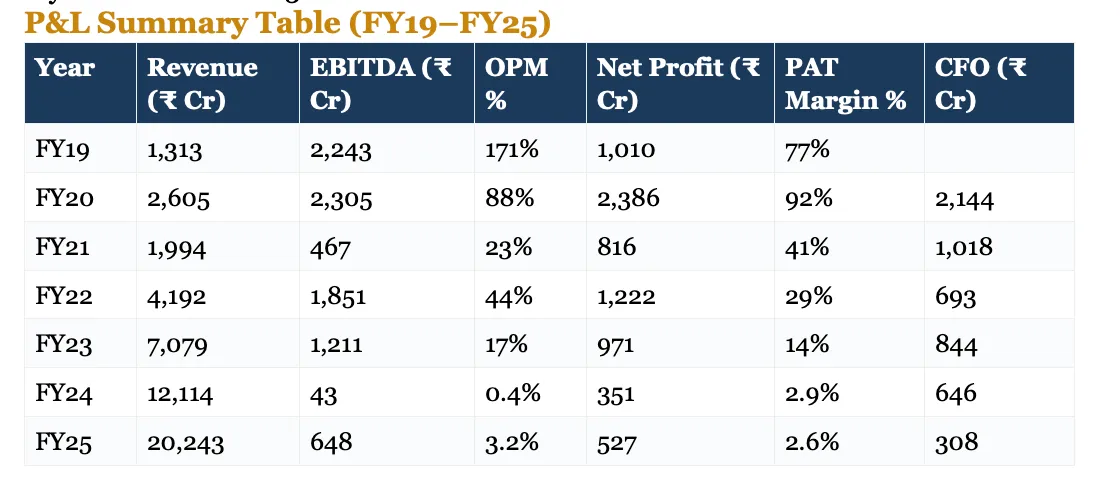
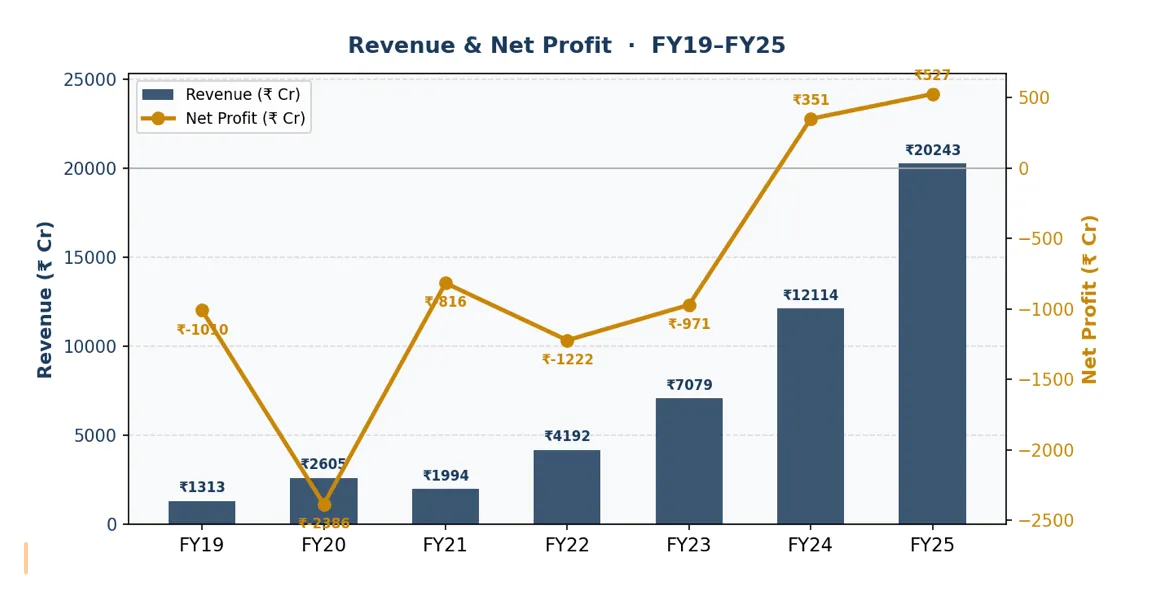
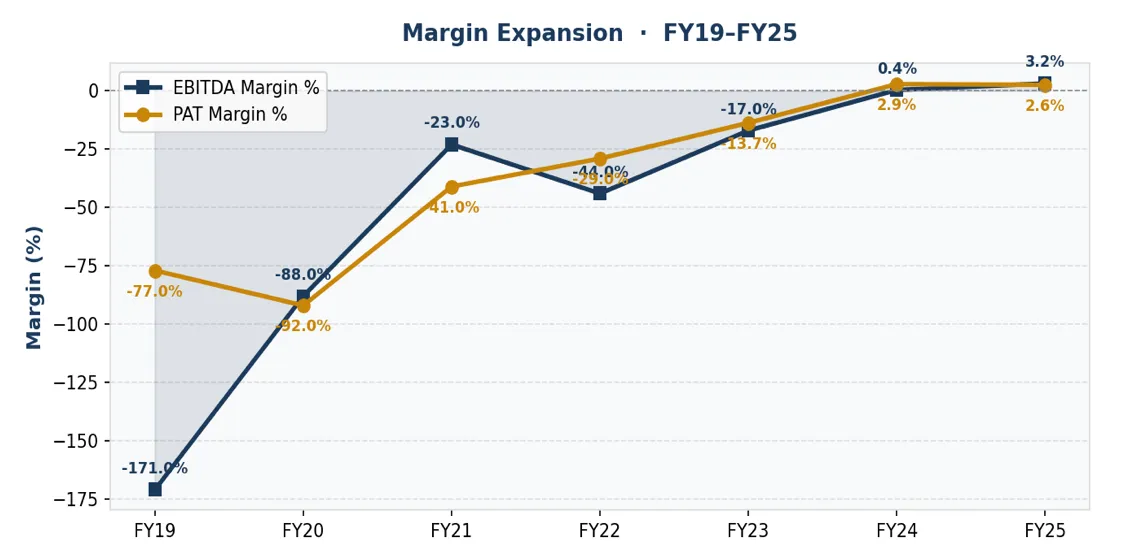
The financial story of Eternal is a story of intentional destruction followed by careful reconstruction. From FY18 to FY23, the company lost over ₹7,500 crore in aggregate, investing in brand, technology, restaurant relationships, and most controversially buying market share in food delivery against Swiggy. That strategy, funded by equity capital rather than debt, was a deliberate choice. The question it raises is whether the resulting market position justifies the investment.
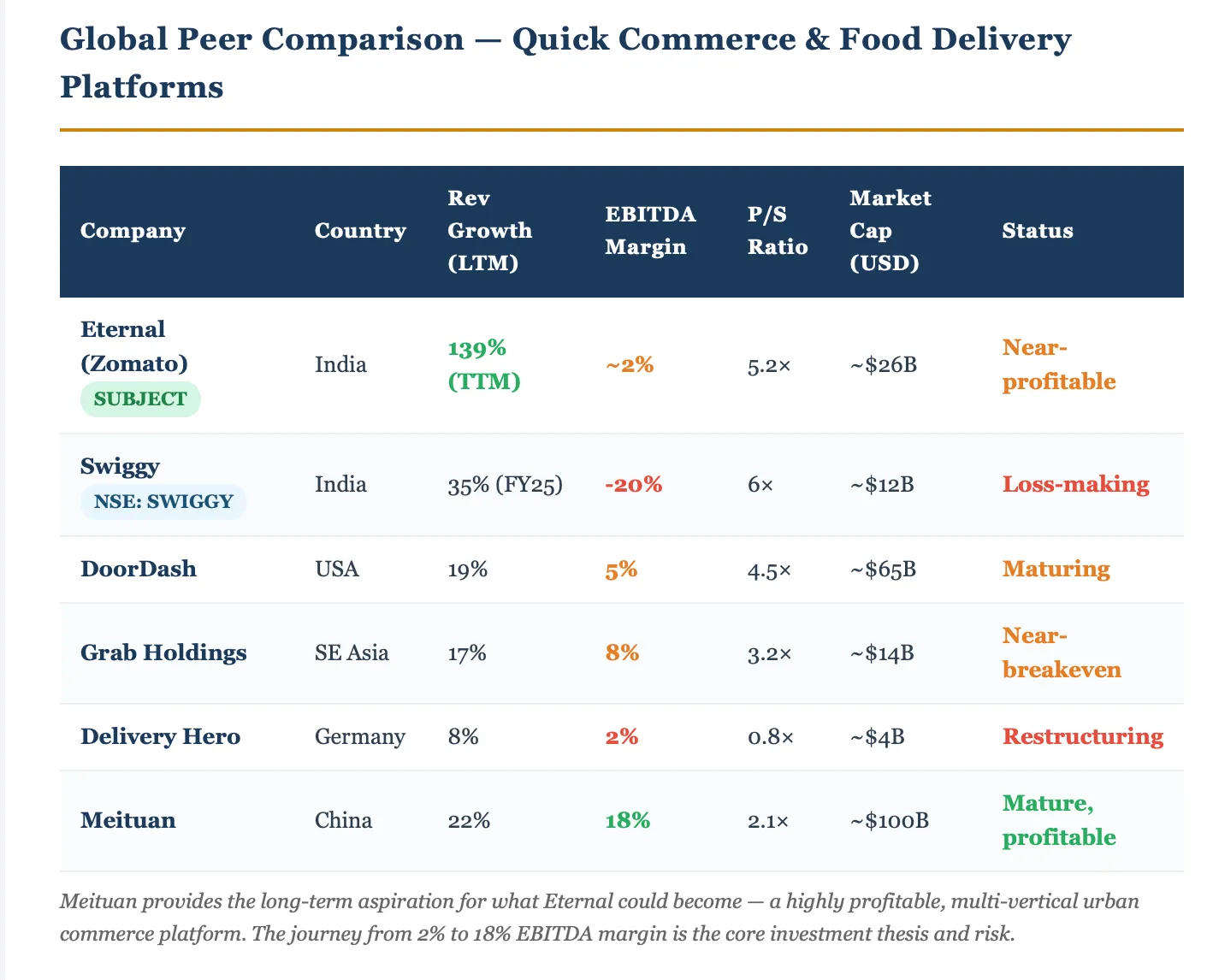
The answer, tentatively, is yes for food delivery and possibly yes for quick commerce but the numbers are still being written. FY24 marked the first year of operating profit (₹43 crore EBITDA). FY25 improved to ₹648 crore EBITDA on ₹20,243 crore revenue. TTM revenues have expanded to ₹42,905 crore, but the accounting model change (marketplace to inventory) inflates these comparisons. What matters is whether EBITDA margins can reach 7–10% sustainably a journey that Meituan completed over 8 years from its 2015 IPO.
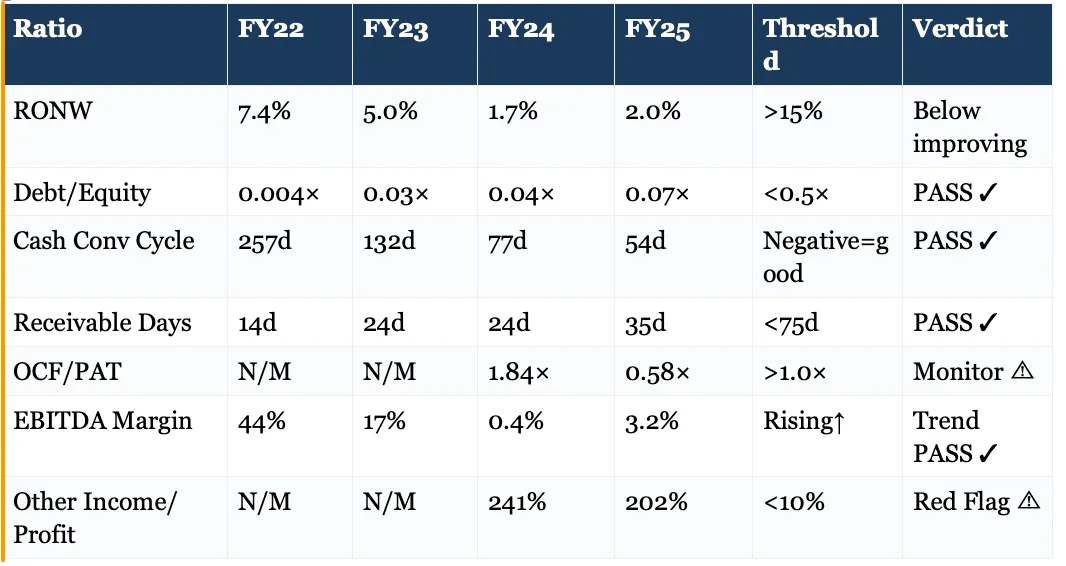
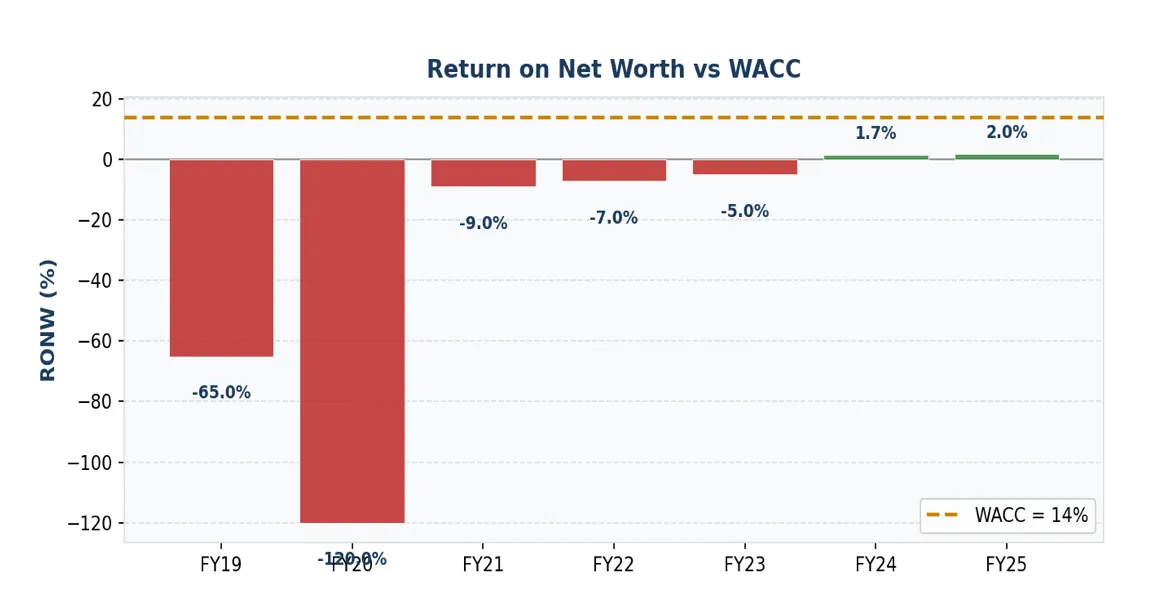
11 ratio test to Eternal requires adjusting the lens for a growthstage platform. Traditional thresholds RONW above 15%, ROA above 10%, OCF/PAT above 1.0× were calibrated for mature businesses with established profitability. Eternal fails most absolute thresholds but shows the right trajectory in nearly every metric.
The most intellectually interesting ratio is the cash conversion cycle: negative 54 days in FY25 (improving from negative 257 days in FY22 due to scale normalization). A negative CCC means the company collects from customers before it pays restaurants essentially operating with supplierfunded working capital. This is a structural platform advantage that improves returns on capital as the business scales. It is the same dynamic that powers Amazon’s retail model.
Quick Commerce Metrics and the Rule of 40
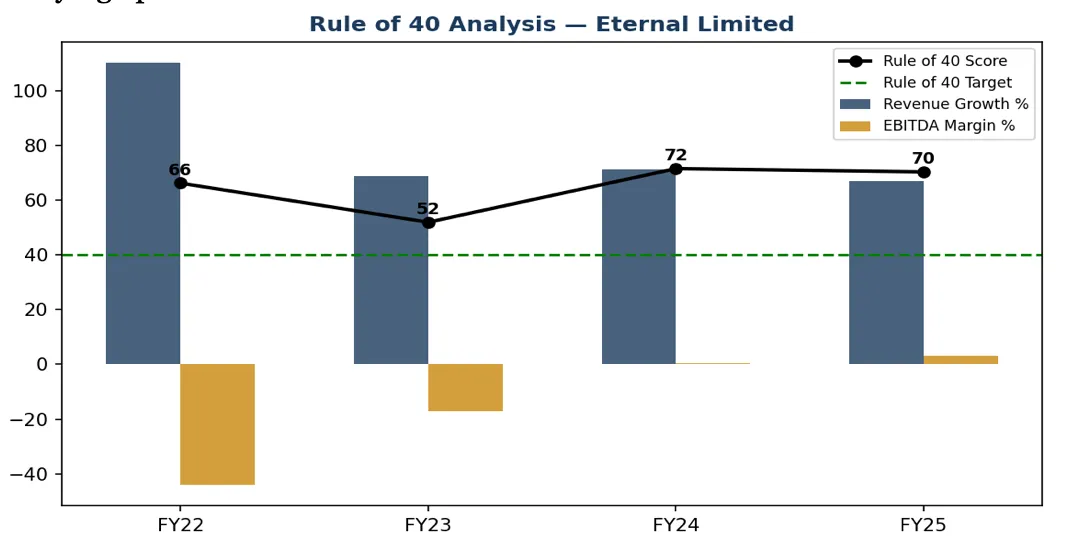
For a platform business in investment mode, the Rule of 40 (Revenue Growth % + EBITDA Margin %) is a more appropriate performance metric than absolute profitability. In FY25, Eternal’s Rule of 40 score stood at approximately 70 (67% revenue growth + 3.2% EBITDA margin) comfortably above the 40point threshold that defines a “healthy” SaaS or platform business. Even in the TTM period, where revenue growth distortion from the inventory model change makes comparison difficult, the underlying operational momentum is constructive.
Part VI: The Risks Inverting for Failure Modes
Munger’s discipline demands that before we ask why an investment will succeed, we exhaustively enumerate why it might fail. Each of the following risks is real, specific, and could permanently impair the investment thesis if it materialises.
Risk 1: Competitive Intensity Prevents Margin Normalisation
Failure Mode: Zepto raises $2+ billion, aggressively discounts quick commerce deliveries in Blinkit’s core metros. Amazon Quick reaches 500 cities by FY27. Flipkart Minutes achieves Meesholike velocity in Tier 2 cities. In response, Blinkit cannot raise delivery fees or commissions, and its contribution margin remains negative indefinitely. Consolidated EBITDA plateaus at 2–3% even as revenue scales. Probability: 30–35%. Confirming signal: Blinkit average order values declining QoQ, or delivery fee reductions.
Risk 2: InventoryLed Model Economics Disappoint
Failure Mode: The shift from marketplace (assetlight) to inventoryled (assetheavy) in quick commerce generates higher revenues but not higher gross profits. Spoilage, overstocking, and privatelabel execution failures lead to gross margins of 8–10% rather than the 15–18% that would justify the model change. This would mean Blinkit revenues are cosmetically large but economically hollow. Probability: 25%. Confirming signal: Gross profit per order declining even as revenue scales.
Risk 3: CEO Transition Execution Risk
Failure Mode: The handover from Deepinder Goyal to Albinder Dhindsa as consolidated CEO, while logical on paper, creates organisational friction across Eternal’s four business pillars. Zomato Food’s management team accustomed to Goyal’s direct oversight struggles under the new structure. Key talent attrition follows. Growth initiatives lose focus. Probability: 20%. Confirming signal: Senior departures in food delivery leadership, or Zomato Food growth deceleration in H1 FY27.
Risk 4: Regulatory Intervention on Commissions
Failure Mode: ONDC gains significant traction with restaurant partners as a lowercommission alternative. Government regulation caps food delivery platform commissions at 15%, compressing Eternal’s take rate from ~22% and reducing food delivery contribution margins by 300+ basis points. Probability: 20%. Confirming signal: ONDC monthly order volumes crossing 10M.
Risk 5: AI Disintermediation (LongTerm)
Failure Mode: By FY29–30, AI agents embedded in smartphones begin placing food and grocery orders autonomously, bypassing platform interfaces entirely. The “app” layer loses relevance as AI models interface directly with restaurant APIs. Eternal’s brand value and consumer relationship diminish. Probability: 15% by FY30. Confirming signal: Material decline in app open rates without corresponding order decline.
Global set up
Part VII: The Valuation What Is This Worth?
Why Platform Companies Command Different Multiples
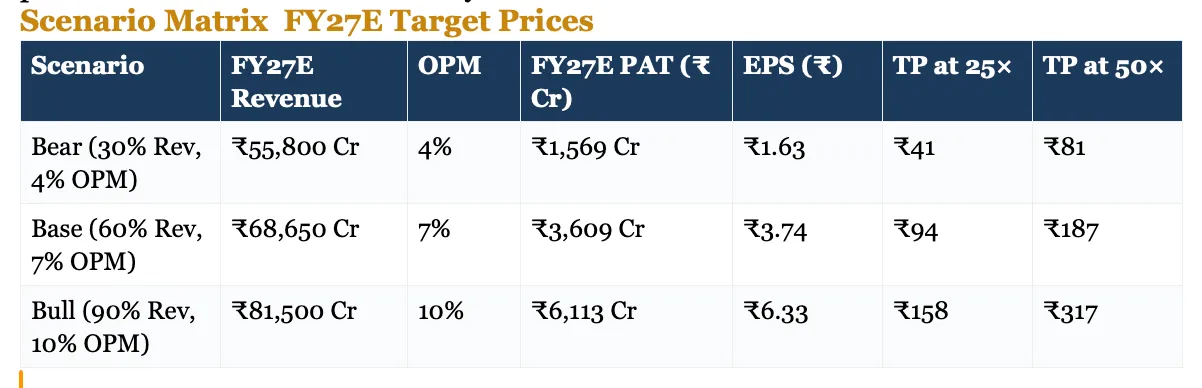
Before constructing the scenario matrix, we must justify why Eternal deserves consideration at any significant multiple. The answer lies in the economics of scale. At 20 million monthly transacting users in food delivery and 13+ million in quick commerce, each incremental order carries minimal marginal cost the dark stores are built, the technology is deployed, the brand is established. If Eternal reaches Meituan’s unit economics (18% EBITDA margin on massive scale), the earnings power from today’s ₹42,000+ crore revenue base is extraordinary. The PE of 959× trailing earnings is misleading; the relevant question is what the PE will be on FY28–29 earnings, not FY25.
A Note on DCF and Why Scenario Analysis is More Honest
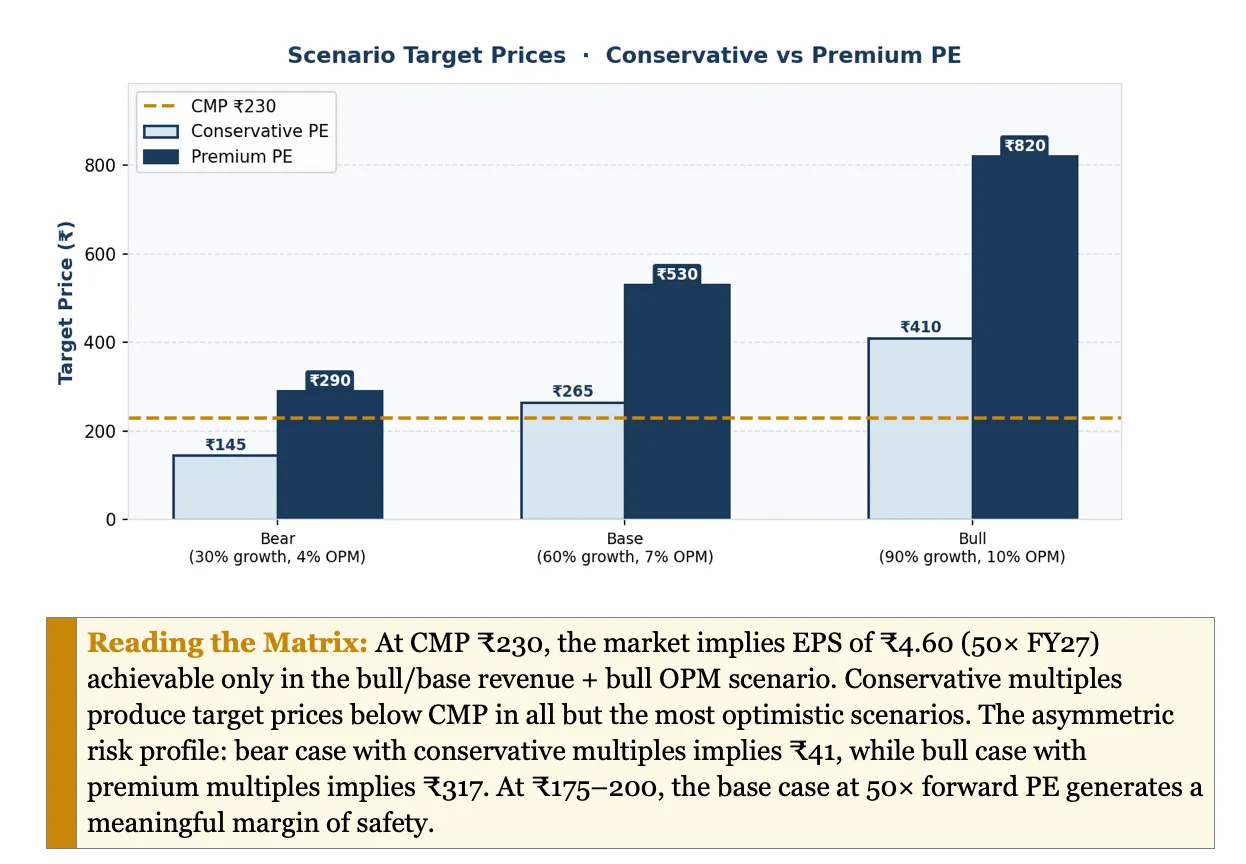
A DCF model for Eternal would produce a wide range of values depending on terminal growth assumptions perhaps ₹120 at pessimistic inputs, ₹600 at optimistic inputs. That width reveals the problem with pointestimate DCFs for young, rapidly evolving platform companies: the terminal value (typically 70–80% of DCF value) is essentially a guess about business conditions 10+ years from now. Scenariobased analysis is more intellectually honest: it explicitly acknowledges the range of outcomes and lets the investor choose which scenario they believe in. Our scenario matrix shows that Eternal is a reasonable investment at the right price and a dangerous one at the wrong price.
Conclusion: The ThreeSentence Thesis
The thesis: Eternal Limited is building India’s most important urban commerce platform a multivertical ecosystem anchored by a dominant food delivery duopoly and a quick commerce leader (Blinkit) with 45% market share, 2,000+ dark stores, and proven ability to scale economically. The margin recovery from nearzero EBITDA toward 7–10% over the next 3–5 years, if achieved, would create significant earnings leverage from the current ₹42,000+ crore revenue base, and the multiple premium warranted for such a platform is substantial. However, at ₹230, the market has already priced in a basetobull execution outcome, leaving investors with asymmetric downside risk.
The #1 risk: Blinkit’s inventoryled model fails to generate the gross margin improvement necessary to offset dark store operating costs and marketing spend, keeping quick commerce losses elevated through FY27 and beyond, while simultaneously the CEO transition disrupts operational momentum in the food delivery business a compounding of two risks that together derate the stock to 15–20× forward earnings.
The final verdict: Watch, study, and buy on meaningful weakness. Eternal at ₹175–200 offers a reasonable margin of safety the base case with conservative multiples generates adequate returns, and the bull case provides meaningful upside. At ₹230, the price demands perfection. Perfection is rarely the right framework for investing.
Disclaimer: This essay is produced ) for informational and educational purposes only. It does not constitute financial advice, a recommendation to buy or sell any security, or an offer of investment services. All investment decisions should be made in consultation with a registered financial advisor after independent due diligence. Past performance is not indicative of future results
As of writing I dont have position in ETERNAL, it may change anytime and I am liable to provide update to you
This is a record of the author's thinking in March 2026, kept as written. It is not a recommendation to buy or sell, and the author may hold the securities discussed. See the disclosures.