RATEGAIN
Every year, a hotel in Udaipur lists its rooms on Booking.com, Expedia, Agoda, MakeMyTrip, Airbnb, and forty-seven other distribution platforms simultaneously. Every night, a revenue manager at a mid-scale chain in Singapore changes her room rates eleven times in response to a competitor’s flash sale, a weekend music festival, and a sudden monsoon forecast. Every quarter, a marketing director at a boutique resort in the Maldives asks her team why their direct booking conversion rate is lower than their OTA conversion and nobody has a convincing answer.
Now ask yourself: who manages all of this, invisibly, at scale, for 3,200 hospitality and travel clients across 100 countries? The answer, almost certainly unknown to most investors who do not work in the travel industry, is RateGain Travel Technologies.
The Business What Does RateGain Actually Do?
The Problem RateGain Solves
To understand RateGain, one must first appreciate the peculiar economics of a hotel room. A hotel room is the most perishable of all inventory unlike a car or a garment, an unsold room on Tuesday night cannot be sold on Wednesday. This means that the pricing decision, made hundreds of times per day across thousands of properties, is extraordinarily consequential. Price too high, and you sit empty. Price too low, and you leave money on the table that can never be recovered.
Now multiply this problem across 200 distribution channels each with its own API, its own rate parity requirements, its own commission structure, and its own booking window characteristics and you begin to appreciate the combinatorial complexity that modern hotels face. No human team, however diligent, can manage this in real time. Technology must do it.
RateGain’s founders, Bhanu Chopra and Megha Chopra, saw this problem clearly when they started the company in 2004. What began as a rate intelligence tool essentially a web scraper that told hoteliers what their competitors were charging has evolved, through a combination of organic development and at least eight acquisitions, into what the company now calls a Travel Technology Platform. The platform does four things.
The Four Product Pillars
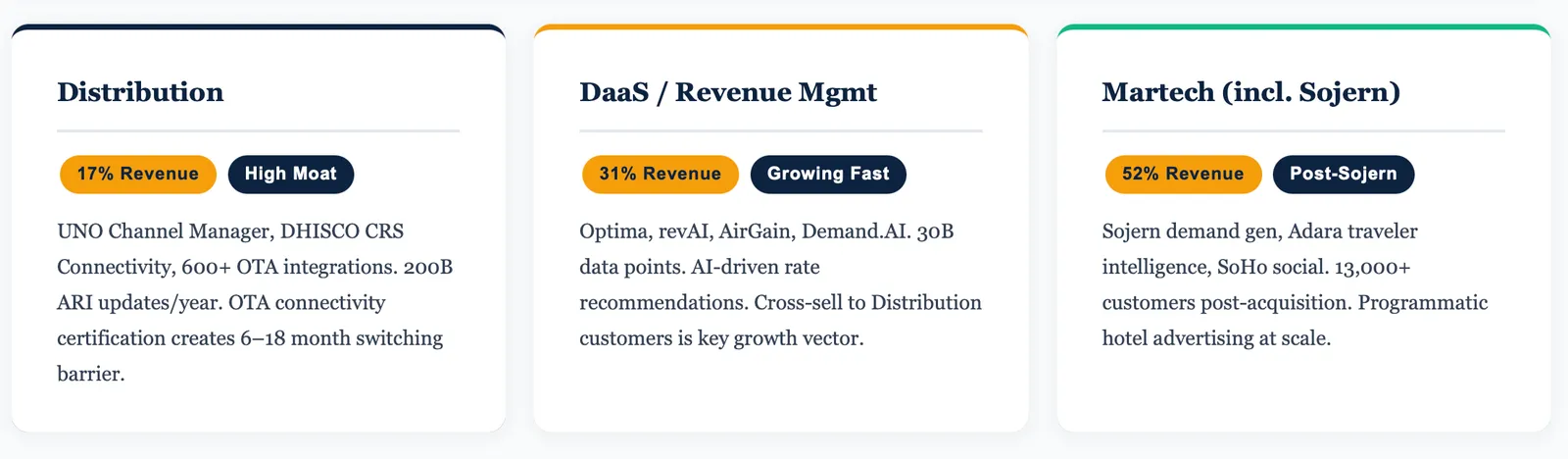
First, there is Distribution. RateGain’s channel management software connects a hotel’s Property Management System to over 500 online distribution channels simultaneously. When a hotel manager changes a rate or opens an allocation, that change propagates to Booking.com, Expedia, Agoda, and 497 other platforms within seconds. This is, from the hotel’s perspective, an operational necessity rather than a luxury. Without it, the alternative is a team of staff manually logging into each channel, a recipe for errors, rate parity violations, and overbookings. RateGain’s competitive advantage here is not its software architecture per se it is the depth and certification status of its channel connections. Booking.com and Expedia do not give Elite or Premier partner certification to just anyone. Earning and maintaining that status requires years of technical investment, volume thresholds, and contractual relationships that new entrants simply cannot replicate quickly.
Second, there is Revenue Management. Under brands like RezGain and Pace Revenue (an acquisition from 2022), RateGain’s Revenue Management System advises hoteliers on what price to charge, not just where to distribute it. This crosses the boundary from operational tool to strategic tool. The software ingests historical demand patterns, competitor rates, local event calendars, weather data, and flight search data to generate dynamic pricing recommendations. The RMS category is where the AI story becomes most credible, because the volume of data inputs makes machine-learning models genuinely superior to human judgment.
Third, there is Marketing Technology. Through acquisitions including BCV Social and Adara, RateGain has assembled a suite of tools for hospitality marketing social media management, reputation monitoring, guest review analytics, and most importantly, first-party data tools that help hotels understand their guests without relying on OTA data (which the OTAs, unsurprisingly, keep to themselves). This pillar addresses a deep structural anxiety among hoteliers: the OTAs know their guests better than they do.
Fourth, and most consequentially for the future, there is Travel Media and Advertising Technology, brought in through the acquisition of Sojern in November 2025 for approximately $250 million. Sojern is a travel-focused programmatic advertising platform that sits between travel brands and their target audiences online. It uses travel intent data flight searches, hotel searches, destination research to serve highly targeted ads on behalf of travel advertisers. This is a meaningfully different business from the other three pillars: it is performance marketing, with revenue tied to advertiser spend rather than hotel subscriptions. We will discuss the strategic logic and the integration risk of this acquisition at length in the valuation section.
The Customer and the Contract
RateGain serves approximately 3,200 customers as of FY2025, primarily hotels, chains, airlines, and online travel agencies. The revenue model is predominantly subscription-based: customers pay an annual or multi-year contract fee for access to the platform, with usage-based uplifts for high-volume clients. This subscription structure is the single most important fact about RateGain’s financial character, because it means that revenue earned today has a very high probability of recurring next year not because of lock-in in the coercive sense, but because the cost and operational disruption of switching is genuinely high.
Consider a hotel that has integrated RateGain’s channel manager into its PMS, trained its revenue team on its RMS interface, and built its marketing dashboard around its analytics. The software is not just a tool it is woven into the daily workflow of the property. Switching costs, in this category, are real.
The Industry Four Secular Growth Vectors
Before we discuss the competitive position of any individual company, we must understand the structural forces that either amplify or constrain the opportunity available to it. RateGain benefits from four distinct secular growth vectors, each of which we will examine in turn.
Vector One: The Structural Recovery of Global Travel
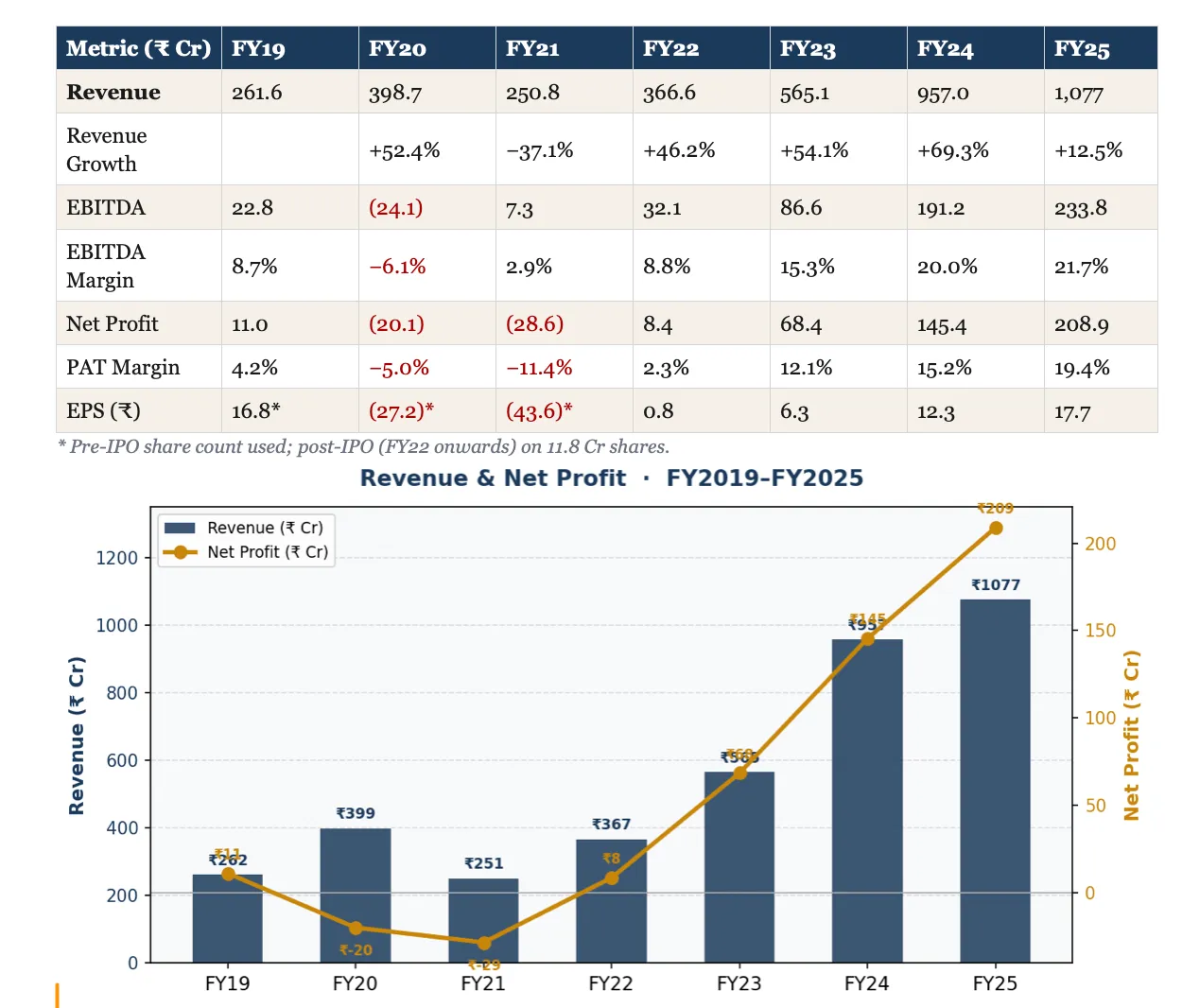
The COVID-19 pandemic inflicted a wound on global travel that was both sudden and severe. International tourist arrivals fell by 73 percent in 2020. For RateGain, whose revenues are denominated in the volume and value of transactions flowing through hospitality and travel clients, the impact was immediate: revenues fell from ₹399 crore in FY20 to ₹251 crore in FY21, a decline of 37 percent. The company lost money in both FY20 and FY21.
But recoveries from exogenous shocks in the travel industry, when they come, tend to be durable rather than temporary. The underlying human desire to travel for leisure, for commerce, for pilgrimage, for the mere joy of being somewhere different does not disappear. It compresses and then releases. By FY23, RateGain’s revenues had more than doubled from their COVID trough. By FY25, they had exceeded the pre-COVID trajectory by a significant margin.
More important than the recovery itself is the structural shift it catalysed. Travel managers, chain hotel executives, and independent property owners who had muddled through with manual processes before the pandemic found, in its aftermath, that they could no longer afford the inefficiency. The pressure to optimize every available room night, every distribution channel, every marketing rupee this pressure was intensified, not relaxed, by the pandemic’s financial wounds. Digitisation of travel operations accelerated during the crisis and has not decelerated since.
Vector Two: The Permanence of OTA Complexity
The rise of the Online Travel Agencies Booking Holdings and Expedia Group between them command roughly 70 percent of global online hotel bookings has created a paradox for hoteliers. The OTAs are, simultaneously, the most important distribution channel available and the most expensive one. A hotel that does not list on Booking.com is invisible to a significant fraction of its potential guests. A hotel that lists on Booking.com pays a commission of 15 to 25 percent on every booking, year after year.
This duopoly dynamic creates a permanent structural demand for tools that help hoteliers manage their OTA relationships more efficiently reducing commission leakage, maintaining rate parity, and building direct booking capabilities. RateGain’s channel management software sits at the heart of this tension. Every new OTA that enters the market (and new platforms continue to emerge, particularly in Asia) adds another integration requirement. Every new API version that Booking.com releases requires RateGain’s engineering team to update its connectivity layer. This is a moat built from operational complexity not glamorous, but extraordinarily durable.
Vector Three: The AI Tailwind in Revenue Optimisation
It would be tempting to dismiss the AI narrative as hype, and for many sectors, that skepticism is warranted. But in the specific domain of dynamic pricing for perishable inventory, machine learning is not a future possibility it is a current competitive necessity. Revenue management systems that can ingest a thousand data signals per minute and generate a pricing recommendation that maximises expected yield per available room are demonstrably superior to systems that rely on spreadsheet-based heuristics maintained by a revenue manager who also has to answer emails.
RateGain has been investing in AI-driven revenue management through its Pace Revenue acquisition and its internal data science team. The company processes over 100 million rate data points daily across its platform. This data flywheel the more clients use the platform, the more data it generates, the better the models become, the more attractive the platform becomes to new clients is a genuine reinforcing loop. It is not, we should note, an impenetrable moat: well-funded competitors like IDeaS (SAS Institute) and Duetto have similar data volumes. But it is a meaningful barrier to pure-play commoditisation.
Vector Four: The Direct Booking Imperative
The fourth vector is perhaps the most underappreciated. Independent hotels and smaller chains have watched with mounting anxiety as the OTAs have accumulated guest data that rightfully belongs to the property. A guest who books through Booking.com is, from the OTA’s perspective, Booking.com’s customer. The hotel gets the revenue from that stay, but Booking.com gets the behavioral data, the email address, and the repeat booking relationship.
This has created a powerful and growing movement among hoteliers toward direct booking investing in their own websites, their own loyalty programs, and their own first-party data infrastructure. RateGain’s marketing technology suite, strengthened significantly by the Sojern acquisition’s travel intent data capabilities, positions the company directly in this secular trend. The hotel that can identify a prospective guest who is searching for a five-night stay in Goa in February, serve that guest a targeted advertisement on Instagram, and convert her into a direct booking rather than an OTA booking has saved itself 15-25 percent in commission fees on that transaction. At scale, this is a powerful economic argument for the category.
The Moat Why This Is Harder to Copy Than It Looks
Charlie Munger has observed that the best businesses are those where the more you use them, the more indispensable they become. This is the essence of a durable competitive advantage not a momentary lead in technology or marketing, but a structural position that strengthens over time through use. Let us apply this test rigorously to RateGain.
The Certification Moat
The most under appreciated source of RateGain’s competitive advantage is its certified connectivity status with the world’s largest travel distribution platforms. Booking.com’s Connectivity Partner Programme has tiers standard partners, preferred partners, Elite partners and the criteria for advancement are not merely technical. They include transaction volume, reliability metrics, customer satisfaction scores, and sustained commercial relationships. RateGain holds Elite or Premier status with Booking.com, Expedia, and several other major OTAs.
A new entrant building a channel management platform cannot simply achieve Elite partner status in year one. The certification history, the volume thresholds, and the contractual relationships that underpin Elite status take years to accumulate. This is a classic example of what Munger calls a ‘tollbooth’ business the traffic must flow through your infrastructure, and the cost of building an alternative infrastructure is prohibitive for most challengers.
The Switching Cost Moat
The second layer of competitive protection is the depth of RateGain’s system integrations. Channel management software does not sit on top of a hotel’s technology stack it is embedded within it. The integration with a hotel’s PMS (Property Management System), its CRS (Central Reservation System), and its booking engine is not a superficial API call. It is a deep, tested, operationally critical connection. When a hotel’s revenue manager opens 20 additional rooms for a peak weekend date, she needs that instruction to propagate to 500 distribution channels in real time without errors. A software switch is therefore not merely a technical decision it is an operational risk that hotel managers are deeply reluctant to accept.
Moreover, RateGain’s contracts tend to run for one to three years, with annual renewal decisions made by senior technology officers who have been trained on the platform and built their workflows around it. The organizational stickiness of enterprise SaaS particularly in a domain as operationally critical as distribution management is substantial.
The Data Flywheel
RateGain processes an extraordinary volume of rate and availability data: over 100 million data points per day across its platform. This data, accumulated over two decades, forms the foundation of its predictive models in revenue management. A competitor entering the market today would need to earn the trust of thousands of hotel clients, accumulate years of historical data across diverse geographies and property types, and then train models on that data to match the prediction accuracy of RateGain’s systems. This is not impossible but it is a multi-year, capital-intensive undertaking.
The flywheel dynamic is real: more clients generate more data, which improves the algorithms, which makes the product more attractive to new clients, which generates more data. But we should be honest about its limits. The flywheel is stronger in relative terms than in absolute terms that is, it gives RateGain an advantage over newer entrants, but it does not prevent well-resourced incumbents like IDeaS (backed by SAS Institute) or Amadeus from maintaining competitive products.
Moat Verdict
Taking all three sources together, the competitive position of RateGain can be summarised as follows: it benefits from high switching costs in its core distribution and RMS products, a certification advantage that is genuinely difficult to replicate quickly, and a data flywheel that compounds its algorithmic advantage over time. These are not the widest moats in the world they do not approach the economic moat of a Visa or a Moody’s. But they are real, they are durable, and they are more substantial than they appear from a surface reading of the company’s annual report.
The Management Fraud Screen and Capital Allocation Test
Sanjay Bakshi teaches that management quality has two dimensions that investors habitually conflate: the ability to run the business competently, and the integrity to do so honestly. A brilliant operator who is willing to manipulate his financial statements is not a good manager in any sense that matters to a long-term owner. Conversely, a scrupulously honest executive who lacks strategic vision will merely preserve value rather than create it. We want both.
Founder Credentials and Skin in the Game
Bhanu Chopra co-founded RateGain in 2004, building it organically for over a decade before taking on external capital. He remains the largest individual promoter, with the promoter group holding approximately 44-45 percent of the company as of FY25. This is not incidental. A founder who holds nearly half the company thinks like an owner, not an agent. His compensation is primarily through capital appreciation, not salary extraction.
The decision to list on the NSE in December 2021 and the subsequent capital raises used to fund acquisitions were made from a position of growth ambition, not financial distress. The balance sheet at IPO was net cash positive, with borrowings having been substantially reduced from their FY20 peak of ₹144 crore to ₹18 crore by FY22. This is the behaviour of a capital allocator who understands the cost of debt.
Applying the Fraud Screen
We subject RateGain’s financials to a systematic forensic accounting screen, drawing on the principles embedded in the Beneish M-Score framework and the fraud identification checklist developed through the AIA investment methodology.
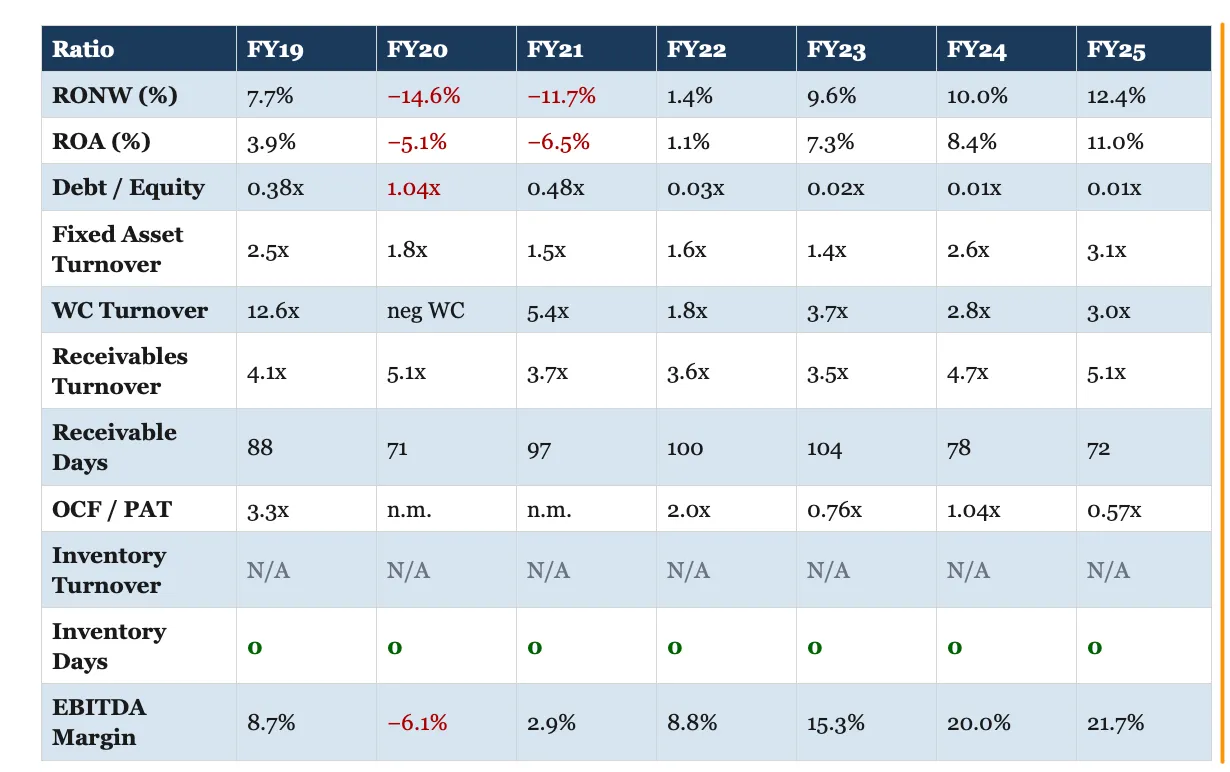
On receivables growth relative to revenue growth: in FY25, revenues grew 12.5 percent year-on-year, while receivables grew only 3.5 percent from ₹205 crore to ₹212 crore. Receivable days improved from 78 to 72. This is a positive sign; a company stuffing the channel or booking fictitious revenues would show the opposite pattern.
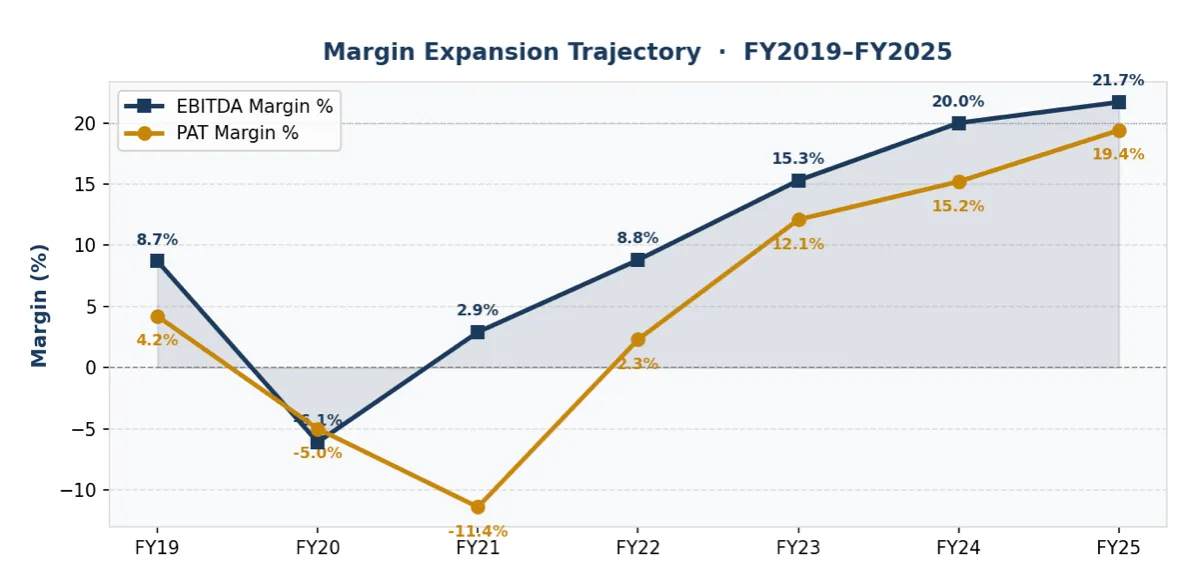
On gross margin consistency: RateGain’s EBITDA margins have been on a consistent upward trajectory from 8.7 percent in FY19, through the COVID trough of negative 6.1 percent in FY20, recovering to 2.9 percent in FY21, and then rising steadily to 8.8 percent, 15.3 percent, 20.0 percent, and 21.7 percent in FY22 through FY25 respectively. This is the pattern of a business with operating leverage, not one with deteriorating fundamentals dressed up with accounting adjustments.
On Other Income: RateGain’s other income has grown from ₹11 crore in FY19 to ₹76 crore in FY25. This is a large number relative to its PBT of ₹272 crore. However, examination reveals that the bulk of this other income consists of interest income on the company’s substantial cash and investment balances which stood at ₹350 crore in cash and ₹319 crore in investments as of FY25. This is a company with nearly ₹670 crore of liquid assets earning a market return. The other income is real, not manufactured.
On debt levels and borrowings: the company carries only ₹16 crore of borrowings against an equity base of ₹1,683 crore as of FY25. The debt-to-equity ratio of 0.01 is essentially zero. This is a balance sheet that cannot be described as overleveraged, regardless of what accounting conventions one applies.
On related party transactions: the disclosures in the annual reports do not reveal any material related party transactions that are unusual in nature. The promoter family has not extracted value through questionable related-party structures. This is a pass.
On auditor quality and tenure: RateGain is audited by B S R & Co. LLP, a KPMG affiliate. The audit opinion has been unqualified in every year reviewed. This is a pass.
The fraud screen, applied honestly, returns a verdict of no material red flags. This does not mean RateGain is beyond manipulation no company can be certified clean in advance but it does mean that the available evidence does not suggest a company that is managing its financial statements to create impressions it cannot sustain.
Capital Allocation The Acquisition Test
The most important question for a management team that has deployed capital through acquisitions is: have those acquisitions created value for shareholders or destroyed it? RateGain has made at least eight acquisitions over its history, including DHISCO (2018), BCV Social (2019), Adara (2019), RezGain, Pace Revenue (2022), and the transformative Sojern acquisition in November 2025.
The acquisitions through FY24 appear to have created value. The revenue per acquisition has compounded nicely, the EBITDA margin trajectory has been steadily improving, and the customer count has grown from a few hundred to over 3,200. The acquired teams appear to have been retained and integrated into the platform rather than absorbed and hollowed out.
Sojern is a different matter. At approximately $250 million representing roughly 40 percent of RateGain’s pre-acquisition market capitalisation Sojern is by far the largest bet Bhanu Chopra has made. The strategic logic is defensible: Sojern brings travel intent data, programmatic advertising technology, and a revenue stream that is complementary to (rather than overlapping with) RateGain’s existing subscription business. But the integration risk is real, the revenue model is different (performance marketing versus subscription), and the purchase price was paid during a period of rising interest rates. We will address the financial implications in the valuation section. For now, we note that capital allocation history prior to Sojern deserves a positive verdict, and that Sojern will be the defining test of this management team’s acquisition judgment.
The Financials Reading the Numbers Honestly
The financial story of RateGain is one of a company building something durable through temporary pain. The COVID years FY20 and FY21 produced losses that would have shaken the confidence of a more financially fragile company. Yet the underlying business did not deteriorate; it merely contracted. When travel returned, RateGain’s revenue model snapped back, and more importantly, the leverage it had built into its cost structure through subscription contracts allowed margins to expand dramatically as revenues recovered.
Seven-Year Financial Summary Profit & Loss
The table below presents the key profit and loss metrics for FY2019 through FY2025, using data from RateGain’s Screener.in financial export.
Seven-Year Business Model Ratio Analysis
The table below applies the our investment framework’s eleven canonical business model ratios to RateGain’s seven-year financial history. These ratios, developed to diagnose the capital efficiency and financial health of Indian businesses, must be interpreted with care for a SaaS company in particular, the inventory-related metrics (which are zero, since RateGain carries no physical inventory) and the fixed asset turnover (which understates asset efficiency because most of RateGain’s assets are intangibles and goodwill, not tangible fixed assets).
Interpreting the Ratios The SaaS Lens
A manufacturing analyst looking at these ratios for the first time might be troubled by the RONW figures: 7.7 percent in FY19, negative for two years, and only 12.4 percent in FY25. By the standards of the AIA framework which was developed primarily for asset-heavy manufacturing businesses these would be mediocre numbers. But the RONW figure for RateGain is deeply misleading, for a reason that any SaaS analyst will immediately recognise.
RateGain’s equity base of ₹1,683 crore as of FY25 includes approximately ₹900-1,000 crore of goodwill and intangible assets arising from its acquisition history. Goodwill represents the premium paid over the net tangible asset value of acquired businesses it is not a productive asset that generates returns. If we were to compute a tangible RONW net profit divided by equity minus goodwill the picture would look substantially more attractive. On a tangible equity base of perhaps ₹700-800 crore, the FY25 RONW would approach 25-30 percent. This is a very different business from what the headline number suggests.
The Inventory Days metric returning zero across all seven years is not an error it is a feature. RateGain carries no physical inventory. It sells software subscriptions. This is the SaaS advantage: the cost of goods sold does not scale proportionally with revenue, which is why EBITDA margins have expanded so dramatically as the company has grown. The marginal cost of serving an additional hotel client is very low primarily customer success and support costs, not manufacturing or procurement costs.
The OCF/PAT ratio, which should ideally exceed 1.0 for a healthy business, deserves a brief note. The 0.57 times in FY25 is lower than desirable, and reflects two factors: an uptick in working capital (receivables have grown as the business has scaled internationally), and the cash deployment ahead of the Sojern transaction. In FY24, the ratio was a healthy 1.04. We expect it to normalise toward 1.0 or above as the Sojern integration proceeds and deferred revenue recognition catches up to cash collections.
SaaS-Specific Metrics
Beyond the traditional ratio framework, three SaaS-specific metrics are critical to understanding RateGain’s financial health. Net Revenue Retention the percentage of revenue retained from existing customers after accounting for churn, contractions, and expansions is management-guided at over 110 percent. This means that even if RateGain signed not a single new customer in a given year, its revenues from the existing customer base would grow by more than 10 percent due to upsells, cross-sells, and price increases. An NRR above 100 percent is the hallmark of a SaaS business with genuine product-market fit and pricing power.
Gross margins, while not broken out explicitly in the Indian GAAP presentation, can be estimated at approximately 68-72 percent based on the company’s cost structure consistent with global SaaS benchmarks for distribution and revenue management platforms. This compares favourably to Indian IT services companies (55-60 percent) and is directionally comparable to global SaaS peers.
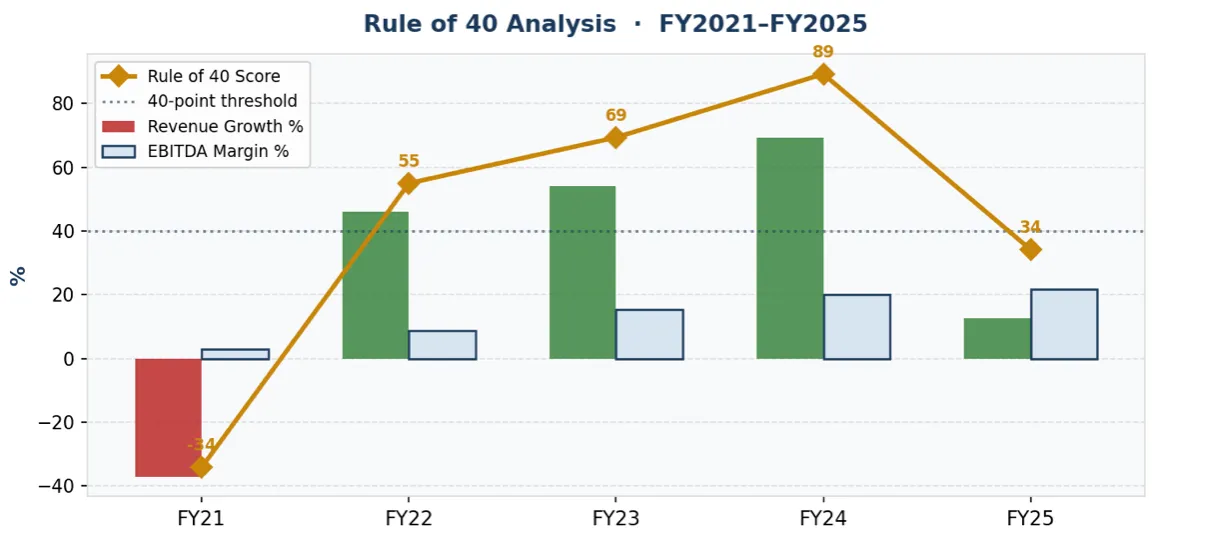
The Rule of 40 the sum of revenue growth rate and EBITDA margin, a composite measure of SaaS efficiency has been impressive in the high-growth years. In FY24, with revenue growth of 69 percent and an EBITDA margin of 20 percent, the Rule of 40 score was an exceptional 89. In FY25, with revenue growth moderating to 12.5 percent (organic growth, as Sojern had not closed), the score fell to approximately 34 below the 40-point threshold. FY26E, incorporating the first full year of Sojern revenues, should restore the Rule of 40 score to a more robust level.
The Risks Invert, Always Invert
Jacobi’s maxim invert, always invert is the most useful discipline in investment analysis. Rather than asking ‘why will this investment succeed?’, we must ask with equal rigour: ‘under what conditions would this investment fail, and how likely are those conditions?’ Charlie Munger has elevated this principle to an art form. Let us apply it seriously.
Risk One: Sojern Integration Failure
The single largest risk facing RateGain shareholders today is the possibility that the $250 million Sojern acquisition fails to generate adequate returns. This risk is not hypothetical. Acquisition integration is genuinely difficult. Sojern is a US-based company with a different business model (programmatic advertising versus subscription software), a different customer base (travel advertisers versus travel operators), and a different revenue recognition pattern. The combined entity must navigate cultural integration, technology integration, and go-to-market integration simultaneously, under the scrutiny of public market investors who have limited tolerance for integration mishaps.
The inversion question is stark: if we imagine a world five years from now in which RateGain’s stock has declined by 50 percent from current levels, the most likely cause is not a global travel crisis or a new competitor it is Sojern. Either the programmatic advertising revenue will have failed to grow as expected, or the integration costs will have been higher than modelled, or the cross-sell between Sojern’s advertising platform and RateGain’s subscription base will have proven less compelling to customers than management hoped. This is not an improbable outcome. Acqui-hires of foreign technology businesses at substantial premiums have historically underperformed for many acquirers.
Risk Two: OTA Disintermediation of Channel Managers
A structural risk that deserves careful thought is the possibility that the major OTAs Booking.com and Expedia in particular decide to build direct PMS and CRS integrations that bypass the channel management layer entirely. If Booking.com were to offer a free, direct API integration to every hotel that used its platform, the economic rationale for paying for a third-party channel manager would be significantly weakened.
We believe this risk is real but overstated. The OTAs have historically shown little appetite for the operational complexity of deep PMS integration it requires sustained engineering investment and creates liability for booking errors. More importantly, the channel management software serves a different purpose: it aggregates hundreds of distribution channels simultaneously, not just the one or two largest. A hotel that dropped its channel manager in favour of Booking.com’s direct connection would still need to manage its connections to Agoda, MakeMyTrip, HRS, and 497 others. That problem does not go away.
Risk Three: Technology Commoditisation by AI
The same AI capabilities that RateGain is investing in as a growth driver also pose a long-term threat. If a general-purpose AI platform could be trained on publicly available rate data and hotel performance benchmarks to provide competent revenue management advice at near-zero marginal cost, the pricing power of RateGain’s RMS products could be undermined. Large language models and foundation models are developing rapidly, and the barriers to building a ‘good enough’ revenue management recommendation engine may be falling.
We take this risk seriously but assess it as medium-term rather than imminent. The network effects in RateGain’s data flywheel the company’s access to live rate data from 3,200 clients across 100 countries gives it a data advantage that a model trained on public data cannot match. Real-time, proprietary, high-frequency data is the input that makes revenue management models genuinely useful. For a new AI entrant to replicate this, it would need willing clients to provide their data which creates its own chicken-and-egg problem.
Risk Four: Customer Concentration and Geographic Exposure
RateGain’s revenues are internationally distributed a strength in terms of diversification but a source of currency risk. A significant portion of revenues is earned in USD, EUR, and GBP, which means an appreciation of the Indian rupee would reduce rupee-denominated revenues. Additionally, while the customer base of 3,200 is broad, any meaningful concentration among large international chain customers would create vulnerability to contract renegotiations or exits.
Risk Five: Promoter Dilution and Corporate Governance
The promoter group’s stake has declined from above 50 percent at IPO to approximately 44-45 percent currently, partly through equity issuances for acquisitions. While this remains a majority-aligned holding, further dilution particularly if used to fund additional acquisitions would reduce the alignment between promoter and minority shareholder interests. Minority investors should monitor promoter holding trends carefully.
The Valuation What Is the Business Worth?
We come now to the question that all the preceding analysis has been in service of: what is this business worth, and what price represents a compelling opportunity? Valuation without understanding the business is speculation. But understanding the business without arriving at a number is merely intellectual pleasure it does not help us decide whether to buy, hold, or sell.
Why Travel-Tech SaaS Commands Different Multiples Than Manufacturing
Before we apply any multiple to RateGain’s earnings, we must address a prior question: why should a travel-technology SaaS business command a higher earnings multiple than a manufacturing compounder of similar growth? The answer lies in the nature of the earnings themselves.
A manufacturing company even a high-quality one must continuously invest capital in plant, equipment, and working capital to generate its revenues. Its earnings are, in a meaningful sense, pledged to maintaining and replacing its asset base. The free cash flow available to shareholders is materially lower than the reported earnings in many years, particularly during expansion phases.
A SaaS business with high gross margins, low capital expenditure requirements, and negative working capital (because subscription customers often pay in advance) generates free cash flow that is close to, or exceeds, its reported earnings. The same rupee of reported profit is worth more when it comes from a SaaS business than from a manufacturing business, because a larger fraction of it is genuinely available to shareholders. This is the mathematical reason why the market assigns higher earnings multiples to quality SaaS businesses.
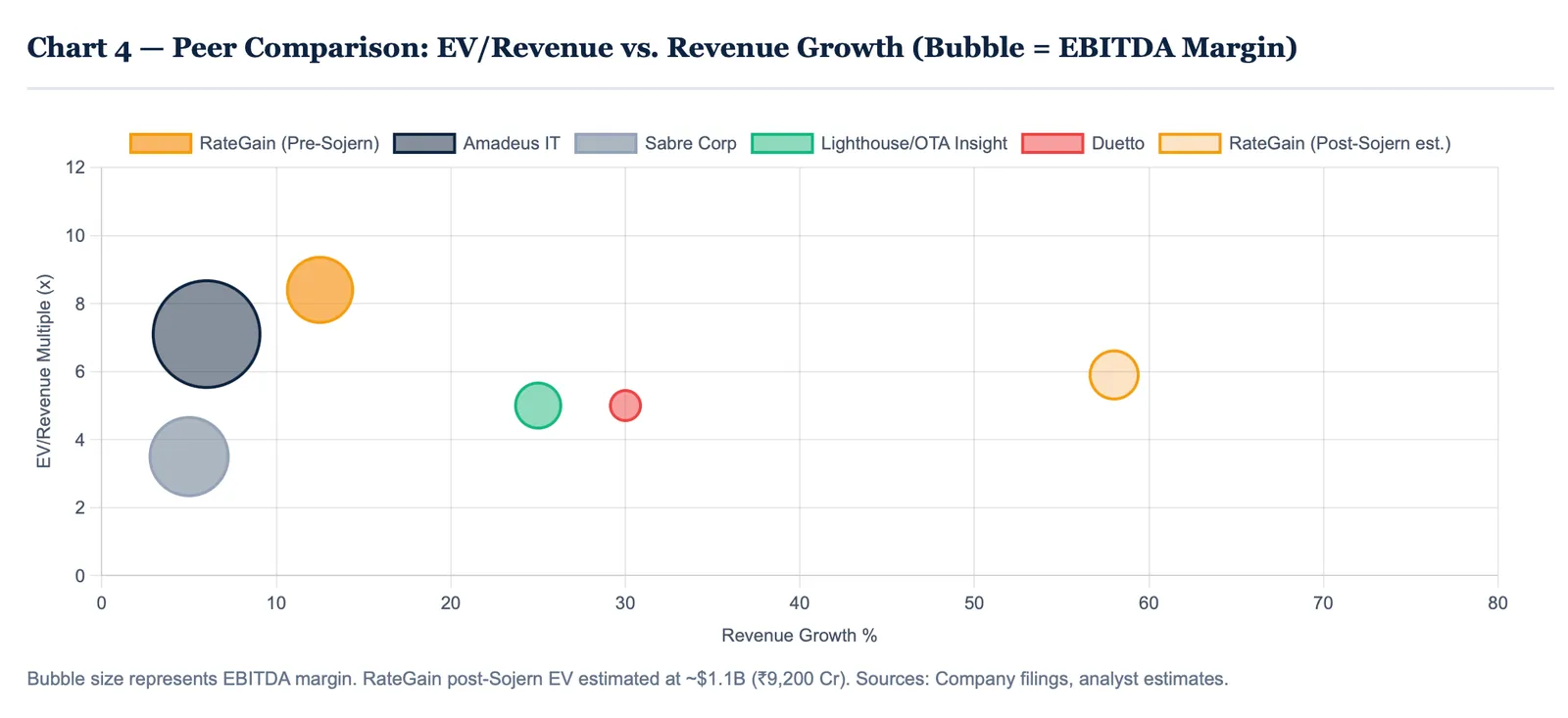
For global SaaS travel-technology comparables companies like FLYR, Duetto, and Amadeus’s distribution technology division earnings multiples of 30-60 times forward earnings are not unusual for businesses with NRR above 110 percent, gross margins above 65 percent, and recurring revenue above 85 percent of total. RateGain meets all three criteria. The conservative range, appropriate for integration uncertainty around Sojern, is 20-30 times forward earnings. The premium range, appropriate if Sojern integration delivers as planned and organic growth reaccelerates, is 40-60 times.
The Three-Scenario Revenue and Margin Framework
We construct our valuation around FY27E earnings a two-year forward view that allows sufficient time for the Sojern integration to show its effects. We anchor our FY26E revenue estimate at ₹1,700 crore, reflecting approximately 5-6 months of Sojern revenues (annualised ARR of approximately $172 million, or roughly ₹1,450 crore, with 5 months contributing around ₹600 crore) combined with organic RateGain growth of approximately 10 percent on its FY25 base.
From the FY26E base of ₹1,700 crore, we model three revenue growth scenarios for FY27E: a Bear case of 8 percent growth (implying Sojern integration struggles, organic growth moderates), a Base case of 15 percent growth (integration proceeds normally, organic growth maintains trajectory), and a Bull case of 22 percent growth (Sojern cross-sell delivers, organic growth reaccelerates). Alongside each revenue scenario, we model three EBITDA margin scenarios reflecting the degree to which integration costs and investment spending are controlled.
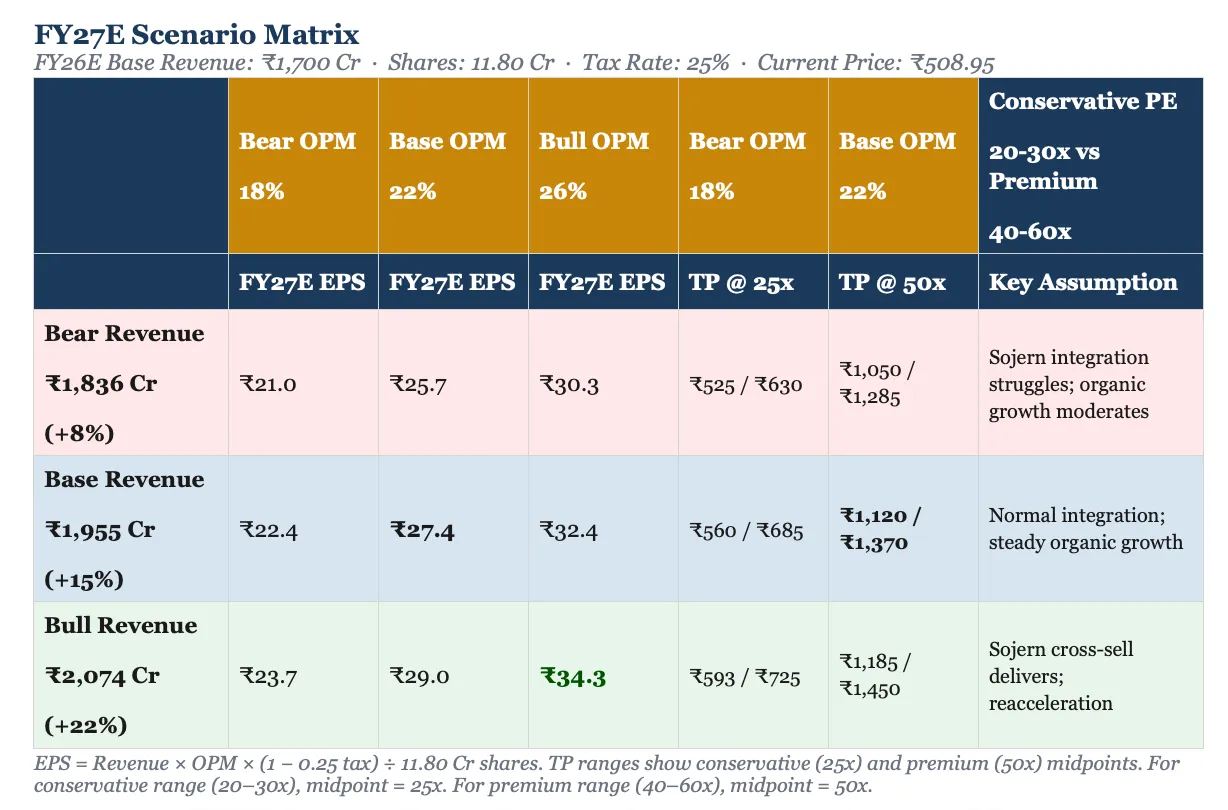
The scenario matrix tells a story that should give both bulls and bears pause for different reasons. Even in the most pessimistic scenario modelled Bear revenue growth of 8 percent combined with a Bear operating margin of 18 percent the FY27E EPS works out to ₹21.0 per share. At a conservative 20-times multiple (the floor of our conservative range), this implies a target price of ₹420. At current levels of ₹509, the stock is therefore trading at a modest premium to the most pessimistic case even on conservative multiples. This suggests that the market is already discounting a meaningful degree of Sojern integration risk which is reassuring.
The base case ₹1,955 crore of revenue at a 22 percent EBITDA margin produces FY27E EPS of ₹27.4. At 25 times, this implies ₹685 a 35 percent upside from current levels. At 40 times (the floor of our premium range), it implies ₹1,096 more than a doubling. The question, then, is not whether there is value in RateGain at current prices there is but whether the risk-adjusted expected value of that upside is sufficient compensation for the Sojern integration uncertainty.
Our answer is a qualified yes. The downside in the bear scenario at conservative multiples is approximately 17 percent from current levels a limited absolute loss. The upside in the base or bull scenario at premium multiples is two to three times current levels over a three-to-five-year holding period. This is an asymmetric risk-reward profile, which is exactly what patient investors should be seeking.
A Note on the DCF
We have chosen to present a scenario-based earnings multiple analysis rather than a discounted cash flow valuation as our primary framework, for a reason worth stating explicitly. A DCF valuation of RateGain is extraordinarily sensitive to the terminal growth rate assumption, because the company’s business model software subscriptions in a growing market is one where cash flows far in the future dominate the valuation. At a 14 percent WACC (our estimate for an Indian technology company with global operations) and an 8 percent terminal growth rate, a DCF model gives you a wide range of outcomes depending on how you model the Sojern integration and the long-term margin profile. The scenario matrix, we believe, communicates the range of outcomes more honestly and more usefully than a point estimate derived from a DCF.
The Thesis in Full
Let us now assemble the pieces.
RateGain Travel Technologies is a B2B SaaS company that has, over two decades, built an operationally critical position in the global travel technology ecosystem. It manages the rate and availability distribution of 3,200 hotel and travel clients across 500+ channels worldwide. Its competitive advantages OTA certification status, deep PMS integrations, a data flywheel processing 100 million rate points per day, and high switching costs are real, durable, and difficult to replicate quickly. Its financial trajectory from COVID losses to ₹209 crore in net profit in FY25, with EBITDA margins expanding from negative 6 percent to positive 22 percent over five years is the story of a business discovering its operating leverage.
The management team, led by founder Bhanu Chopra, has passed the fraud screen without material concerns and has a creditable acquisition track record through FY24. The Sojern acquisition is the defining test ahead: a $250 million bet on travel advertising technology that either extends RateGain’s platform into a fourth pillar of genuine scale, or proves to be the acquisition that stretched the organisation beyond its integration capacity.
The industry tailwinds are real and secular: the global recovery of travel, the permanence of OTA complexity, the AI imperative in revenue optimisation, and the direct booking movement all create growing demand for exactly the kind of tools RateGain builds. The risks are non-trivial: Sojern integration failure, OTA disintermediation, technology commoditisation, and the governance questions that arise whenever a promoter dilutes below majority control.
On valuation, the current price of ₹508.95 represents a forward earnings multiple of approximately 19-20 times our FY27E base case EPS below the floor of what we would consider a premium multiple for a business of this quality. Even at conservative multiples, the base case produces a target price of ₹685-822 (25-30 times FY27E EPS), representing 35-62 percent upside over two years. At premium multiples warranted if Sojern delivers and organic growth reaccelerates the target price range of ₹1,096-1,644 represents two to three times the current price.
The investor’s chief problem and even his worst enemy is likely to be himself. Benjamin Graham
The chief discipline required to benefit from RateGain’s potential is patience. The Sojern integration will not resolve itself in a quarter or two. The travel technology market does not move at the pace of consumer social media. The compound annual growth in intrinsic value that this business is capable of delivering over a five-year period will not be delivered in a straight line there will be quarters of integration confusion, margin pressure, and analyst downgrades. The investor who can sit through those episodes, secure in the knowledge that the underlying business model is sound and the management team is aligned with minority shareholders, is the investor who will capture the value.
Our conclusion, stated plainly: RateGain Travel Technologies is a business of above-average quality, led by a founder-operator with demonstrated acquisition skill, operating in a growing market with structural tailwinds, available at a price that implies a modest premium to the most pessimistic scenario. The Sojern acquisition is a genuine risk that warrants monitoring. But for the long-term investor who understands travel technology, has done the work on management quality, and accepts the Sojern uncertainty as the price of entry, the risk-reward at current prices is compelling.
We hold this view with appropriate humility. The market knows things we do not. But from the information available, and applying the frameworks we have described, the balance of evidence points to a business that is worth considerably more than its current market capitalisation implies.
This is not investment advice and author may or may not have position in the stock.
This is a record of the author's thinking in April 2026, kept as written. It is not a recommendation to buy or sell, and the author may hold the securities discussed. See the disclosures.