Novel Drug Discovery Company from India
From 2014 I have covered Suven extensively on Tankrich, you can go through some of my previous posts here 2014, 2015 ,2017, 2018 , 2019 , 2020
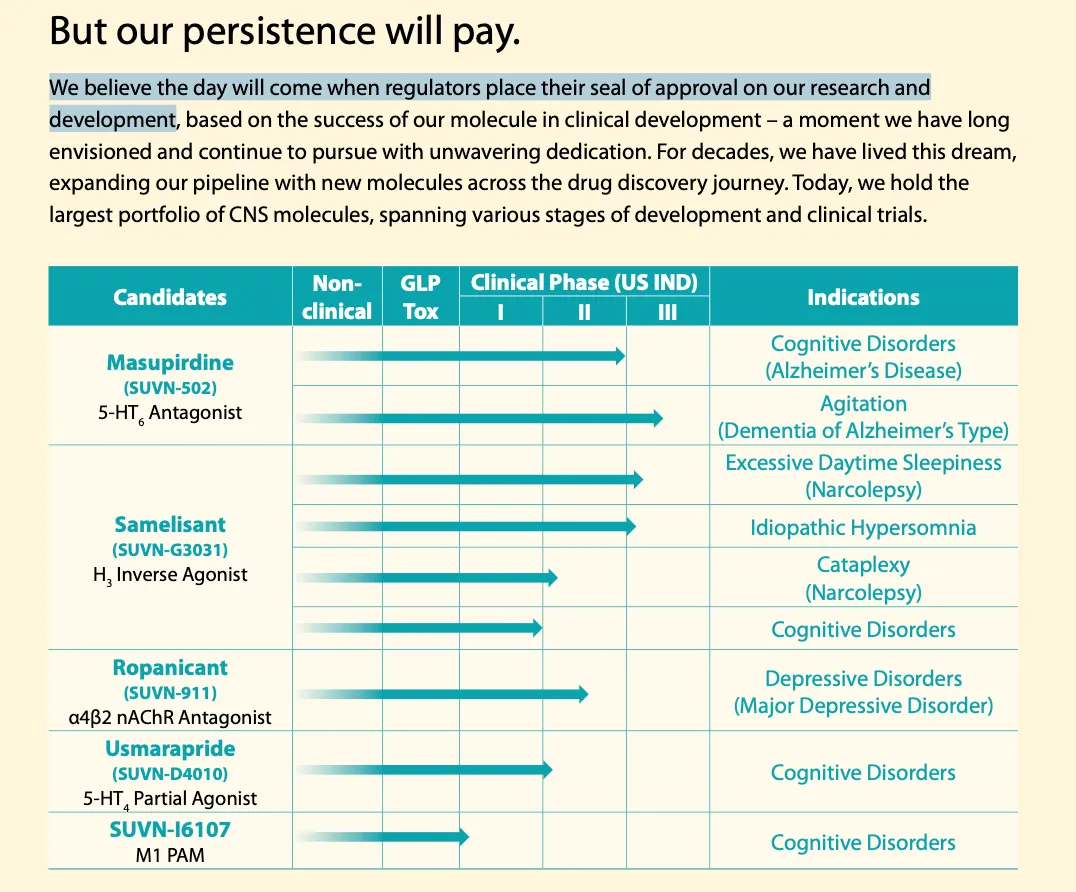
In its new Avatar - Suven Life Sciences is a biopharmaceutical company focused on CNS disorders, It has five candidates in clinical trials, targeting conditions like Alzheimer’s, depression, and narcolepsy, with novel mechanisms that could address unmet medical needs.
What caught my attention?
Suven Life Sciences raised ₹857 crore through the issuance of 64 million fully convertible warrants on a preferential basis, approved on July 3, 2025, and allotted to 23 entities at INR 134/share with decent share from Notable Non-Promoter Investors:
-
Sunil Singhania (Abakkus Diversified Alpha Fund): A prominent market veteran, his participation signals confidence in Suven’s pipeline.
-
Prashant Jain (3P India Equity Funds): Another respected investor, managing funds that took significant stakes.
-
Quant Mutual Fund: A major institutional investor, reflecting broader market interest.
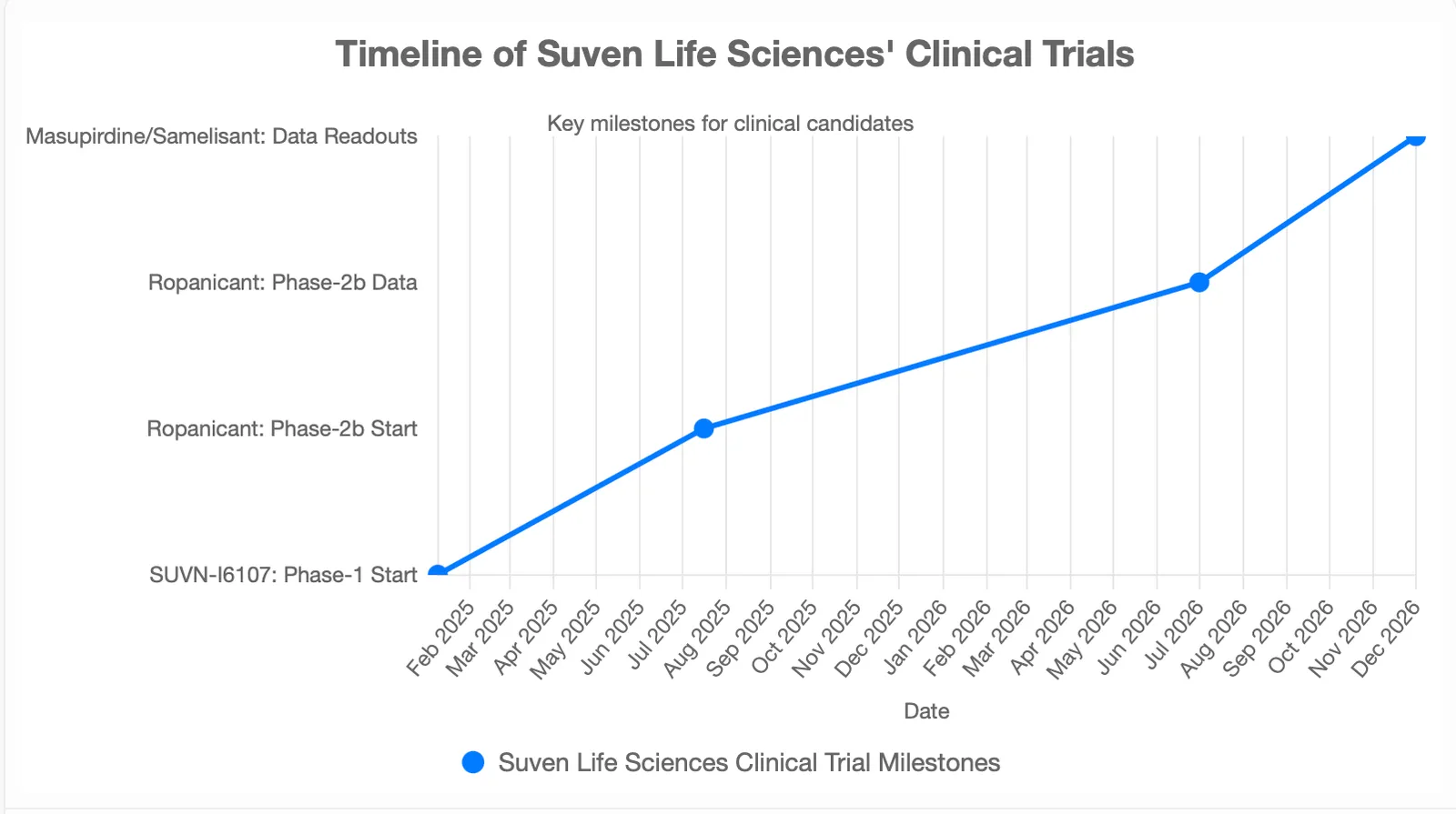
The next two years have very interesting events lined up and thats the reason stock price is up over 100% in less than 12 months.
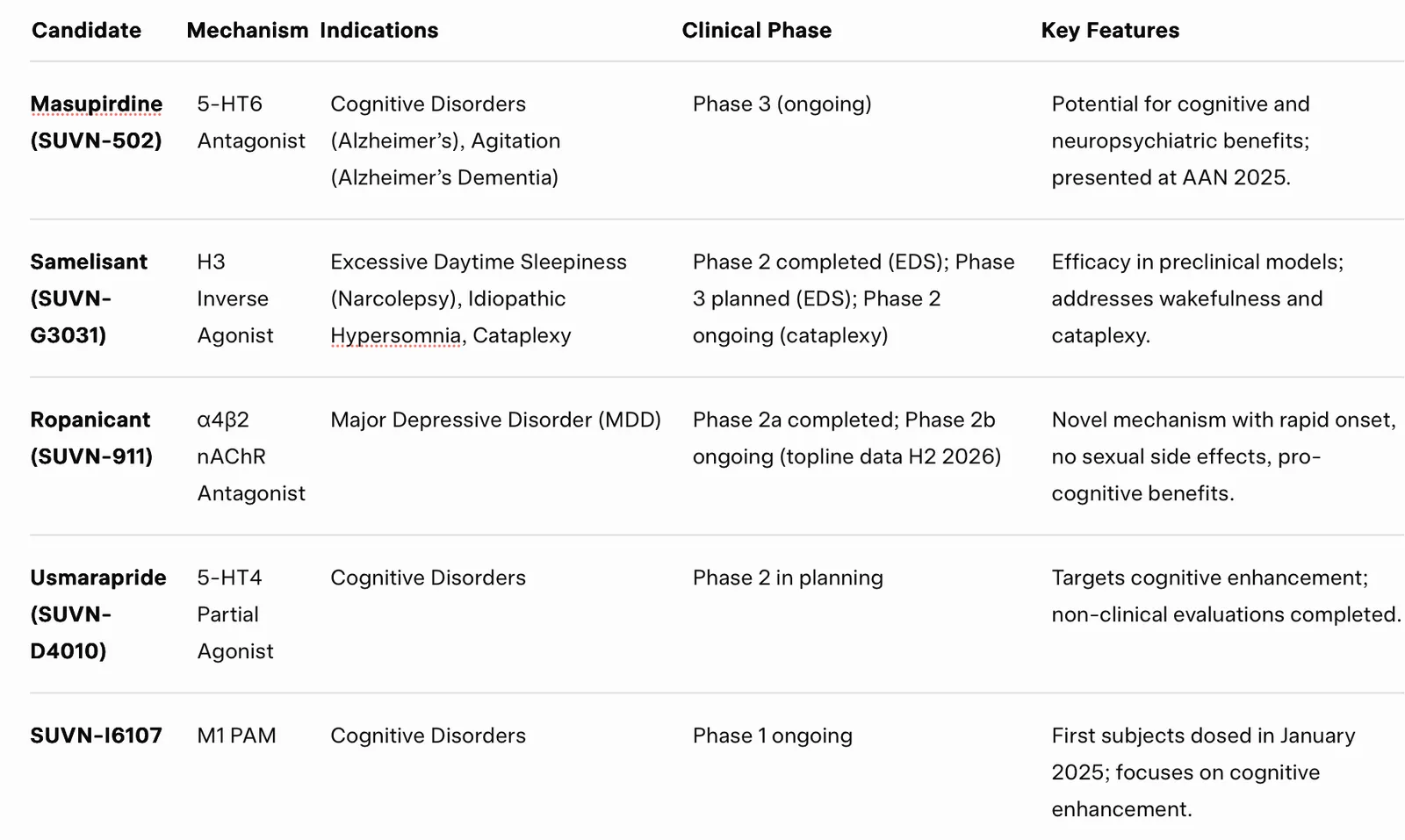
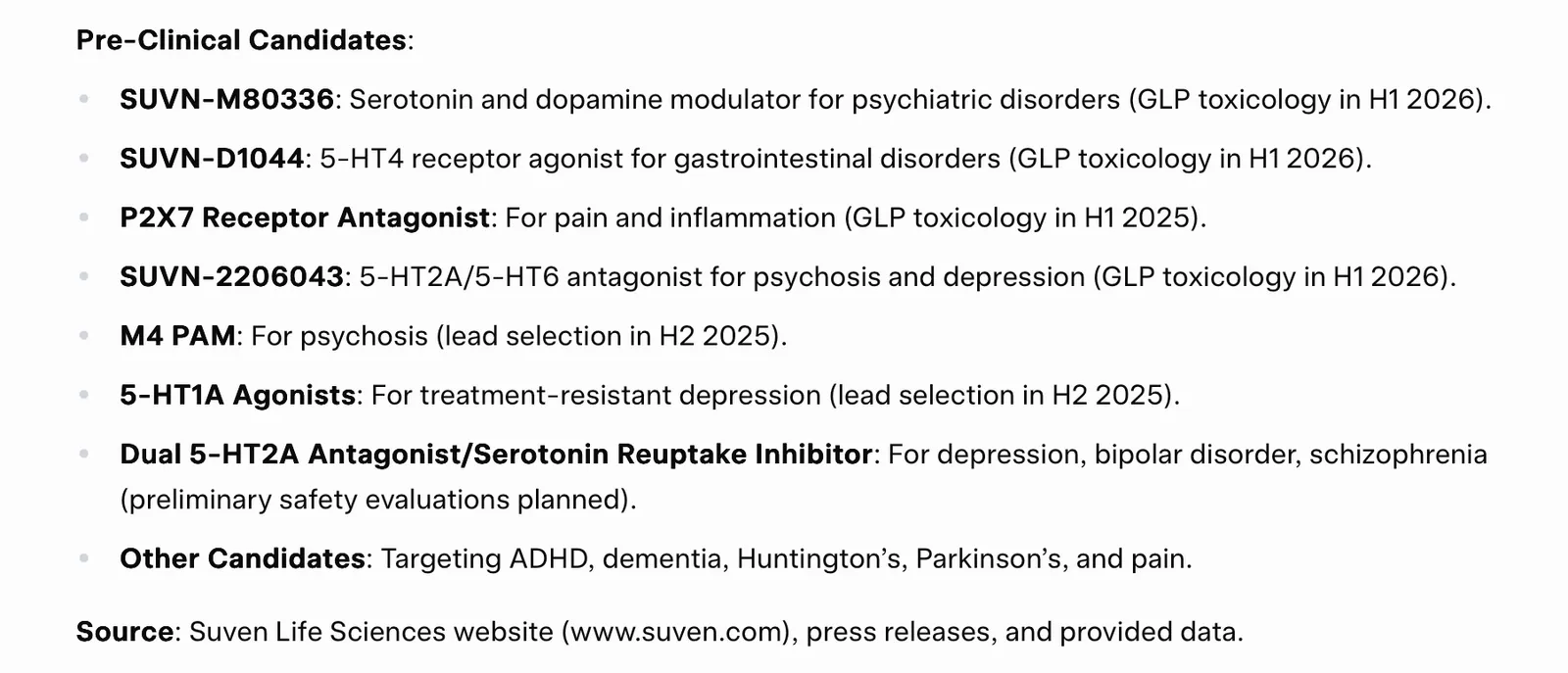
Here is more detailed breakdown of their molecules
The CNS drug development landscape is highly competitive, with both large pharmaceutical companies and smaller biotechs vying for market share. Key competitors include below
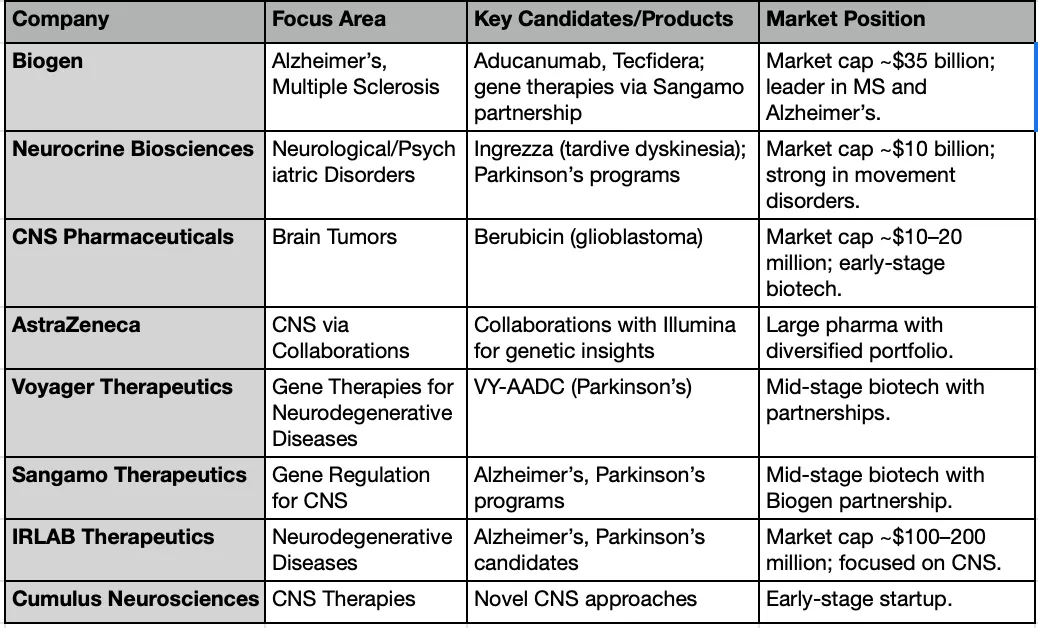
some of key trends observed in this space are
-
Large pharma (e.g., Pfizer, Novartis, GSK) have scaled back CNS programs due to high failure rates, leaving opportunities for smaller biotechs like Suven.
-
Suven’s novel mechanisms (e.g., α4β2 nAChR antagonism for Ropanicant) differentiate it from competitors with traditional approaches (e.g., SSRIs for depression).
-
The MDD market is crowded with generics (e.g., sertraline), but novel drugs like SPRAVATO (esketamine) and pipeline candidates (e.g., aticaprant) compete with Ropanicant.
-
Alzheimer’s agitation has limited approved treatments (e.g., off-label antipsychotics), giving Masupirdine a potential edge.
Chances of Success
CNS drug development is challenging, with low success rates due to complex biology and trial design issues.
-
Overall Success Rate: Only ~6.2% of CNS drugs entering clinical trials gain approval, compared to 13.3% for non-CNS drugs
-
Phase 2/3 Failure Rate: ~85% of CNS drugs fail in Phase 2 or 3, second only to oncology
-
Development Time: CNS drugs take ~12.8 months longer to develop than non-CNS drugs.
Now lets look at Suven Specific factors
-
Positive Early Data: Ropanicant’s Phase 2a success (significant MADRS score improvement) and Masupirdine’s Phase 3 progress suggest potential.
-
Novel Mechanisms: Candidates like Ropanicant (α4β2 nAChR antagonist) and Masupirdine (5-HT6 antagonist) target unique pathways, potentially improving efficacy signals.
-
Unmet Needs: High demand for effective treatments in MDD (~280 million globally), Alzheimer’s (~55 million with dementia), and narcolepsy (~4 million) supports market potential.
-
Trial Design: Suven’s focus on non-treatment-resistant MDD for Ropanicant and specific Alzheimer’s populations for Masupirdine may reduce placebo response risks.
Estimated Success Probabilities:
-
Ropanicant: ~40–60% chance of Phase 2b success, based on Phase 2a results and industry benchmarks (~31–50% for MDD trials).
-
Masupirdine: ~50–70% chance of Phase 3 success, given its advanced stage and unmet need in Alzheimer’s agitation.
-
Samelisant: ~40–60% chance of Phase 3 success, supported by Phase 2 EDS data.
-
Usmarapride/SUVN-I6107: ~30–40% chance of advancing from Phase 1/2, due to earlier stages and higher attrition rates.
CNS drug development faces significant hurdles, contributing to high failure rates:
-
Biological Complexity: Incomplete understanding of CNS disease mechanisms complicates target validation.
-
Blood-Brain Barrier: Drugs must be lipophilic to cross, limiting candidates.
-
High Placebo Response: MDD trials often see 30–40% placebo response, obscuring efficacy.
-
Late-Stage Failures: CNS drugs frequently fail in Phase 2b/3 after significant investment.
-
Regulatory Challenges: Strict FDA standards for safety and efficacy increase approval barriers.
Suven-Specific Risks:
-
Early-Stage Candidates: Usmarapride and SUVN-I6107 face higher attrition in Phase 1/2 (~70–80% failure rate).
-
Trial Design Risks: Soft endpoints (e.g., MADRS for Ropanicant) and multi-center trials (35 US sites for Ropanicant) may introduce variability.
-
Competition: Established drugs (e.g., SSRIs, Tecfidera) and pipeline candidates (e.g., aticaprant, AVP-786) could overshadow Suven’s offerings.
The global CNS therapeutics market was valued at $140.44 billion in 2024, projected to grow at a 10.4% CAGR to 2030 , they key players are below
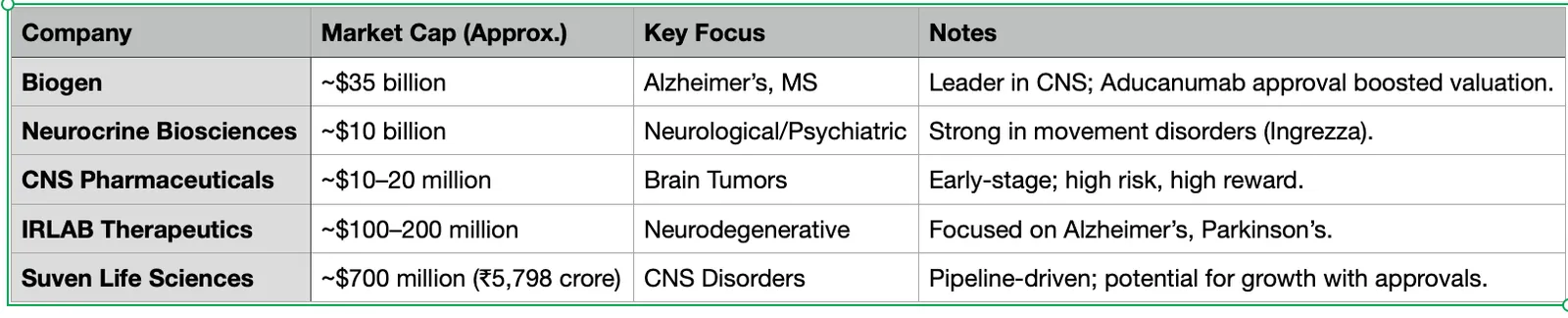
Suven is actively pursuing partnerships, strategic collaborations, and outlicensing to fund and accelerate development. Their 2,850 global patents (expiring 2035+) enhance their appeal. Timelines are tied to clinical milestones
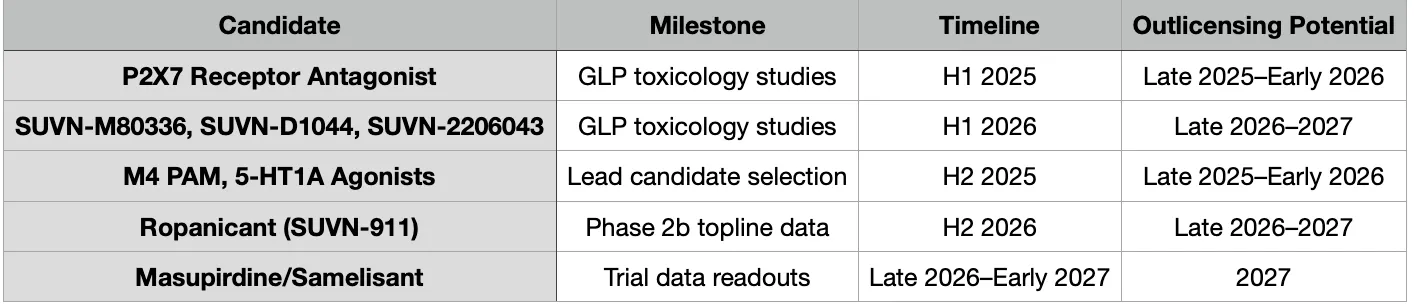
Big Pharma is always in hunt for these deals because of Novel mechanisms and unmet needs (e.g., Alzheimer’s agitation, rapid-onset MDD treatments) attract larger pharma seeking CNS portfolio expansion. We have recently big deals as well
Biogen’s $2.72 billion deal with Sangamo and Neurocrine’s $1.7 billion deal with Voyager highlight CNS outlicensing potential
if all works out we are looking at big revenue numbers but take with pinch of salt :)
Summary
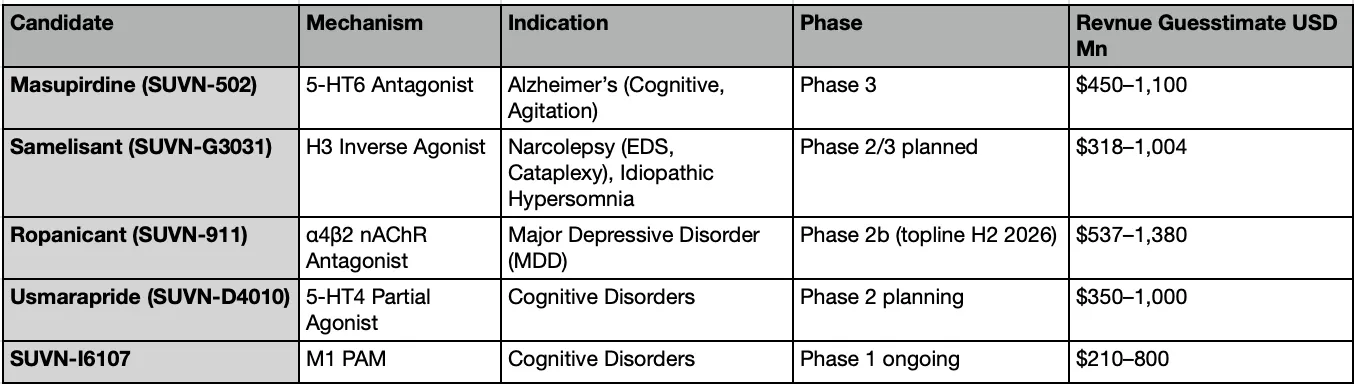
Details
Masupirdine (SUVN-502) – Cognitive Disorders (Alzheimer’s Disease) and Agitation (Dementia of Alzheimer’s Type)
-
Market Size:
-
Alzheimer’s Disease (AD) Cognitive Disorders: The global AD market was USD 3.86 billion in 2024, projected to reach USD 7.0 billion by 2032 (7.6% CAGR). The cognitive impairment segment is significant, driven by ~55 million people with dementia globally (2020), with AD accounting for 60–70% of cases (~33–39 million).
-
Agitation in AD Dementia: The neuropsychiatric symptom market for AD (including agitation) is smaller but growing. Agitation affects ~40–60% of AD patients (~13–23 million globally). The AD neuropsychiatric market is projected to reach USD 1–2 billion by 2030, as part of the broader AD market.
-
-
Unique Attributes:
-
As a 5-HT6 antagonist, Masupirdine targets cognitive deficits and agitation, distinct from amyloid-targeting drugs like Leqembi or Aduhelm. Its Phase-3 status for agitation suggests advanced development, with potential for earlier market entry (~2028–2029).
-
No approved drugs specifically target AD agitation (except off-label antipsychotics like risperidone), creating an unmet need. Masupirdine’s focus on both cognition and agitation could differentiate it.
-
-
Competition: AD cognitive drugs face competition from Leqembi (USD 2.7 billion projected by 2030), donanemab, and generics. Agitation treatments compete with off-label drugs and pipeline candidates like AVP-786 (Phase-3 for AD agitation).
Samelisant (SUVN-G3031) – EDS (Narcolepsy), Idiopathic Hypersomnia, Cataplexy (Narcolepsy)
-
Market Size:
-
Narcolepsy (EDS and Cataplexy): The narcolepsy market was USD 3.28 billion in 2023, projected to reach USD 5.36 billion by 2030 (7.3% CAGR). Narcolepsy affects ~1 in 2,000 people (~4 million globally, ~165,000 in the US), with EDS and cataplexy as key symptoms.
-
Idiopathic Hypersomnia (IH): The IH market is smaller, with prevalence of ~50–100 per 100,000 (~0.3–0.6 million globally). The IH treatment market is estimated at USD 0.5–1 billion by 2030, driven by unmet needs.
-
-
Unique Attributes:
-
As an H3 inverse agonist, Samelisant targets wakefulness and cataplexy, potentially offering advantages over stimulants (e.g., modafinil) or sodium oxybate (Xyrem). Phase-2 completion for EDS and planned Phase-3 suggest progress toward approval (~2029–2030).
-
Its broad indications (EDS, IH, cataplexy) could capture multiple niche markets.
-
-
Competition: Competes with Wakix (pitolisant, H3 antagonist, USD 582 million in 2023), Xyrem generics, and pipeline drugs like AXS-12. Samelisant’s efficacy and safety profile will be critical.
Ropanicant (SUVN-911) – Major Depressive Disorder (MDD)
-
Market Size: The MDD market was USD 11.86 billion in 2023, projected to reach USD 15.34 billion by 2032 (2.9% CAGR). Depression affects ~280 million people globally, with ~21 million US adults annually (~14 million non-TRD).
-
Unique Attributes: As a first-in-class α4β2 nAChR antagonist, Ropanicant offers rapid onset, no sexual side effects, and pro-cognitive benefits (Phase-2a results). Phase-2b topline data is expected in H2 2026, with approval possible by ~2029–2030.
-
Competition: Competes with SSRIs/SNRIs, SPRAVATO (esketamine), Auvelity, and pipeline drugs like aticaprant (USD 670.63 million projected by 2029). Rapid onset and side effect profile could drive adoption.
Usmarapride (SUVN-D4010) – Cognitive Disorders
-
Market Size: Shares the AD cognitive disorders market with Masupirdine (~USD 7.0 billion by 2032). Cognitive disorders also include mild cognitive impairment (MCI), with a broader market potential of USD 8–10 billion by 2030.
-
Unique Attributes: As a 5-HT4 partial agonist, Usmarapride targets cognitive deficits, potentially complementing Masupirdine. Phase-2 is in planning, suggesting approval by ~2030–2032.
-
Competition: Similar to Masupirdine, competes with Leqembi, donanemab, and other cognitive-enhancing drugs. Differentiation will depend on efficacy data.
SUVN-I6107 – Cognitive Disorders
-
Market Size: Same as Usmarapride and Masupirdine (~USD 7.0–10 billion by 2032).
-
Unique Attributes: As an M1 PAM, it targets muscarinic receptors, a novel approach for cognitive enhancement. Phase-1 status indicates earlier development, with approval likely post-2032.
-
Competition: Similar to Masupirdine and Usmarapride, with additional risk due to earlier stage and unproven efficacy.
Suven Life Sciences is well-positioned in the high-risk, high-reward CNS drug development space. Their pipeline, led by Masupirdine and Ropanicant, targets significant unmet needs with novel mechanisms. However, the 85% failure rate in Phase 2/3 CNS trials pose challenges ,Successful clinical outcomes could drive Suven’s valuation toward mid-tier CNS biotechs ($2–5 billion), with outlicensing deals in 2025–2027 providing critical funding. Monitoring trial progress (e.g., Ropanicant’s Phase 2b data in H2 2026) and partnerships will be key.
Investing in Suven Life Sciences at its current valuation (~$770 million) is a high-risk, high-reward bet. The company’s pipeline is promising, with potential to generate $1.87–5.28 billion annually by 2032 if successful, but the CNS drug development space has a low success rate (~6% overall). The recent fundraising and outlicensing potential are positive, but investors should be prepared for volatility and monitor key milestones like Ropanicant’s Phase 2b data in H2 2026.
Think long-term, diversify, and stay informed about trial outcomes and competitive dynamics.
Risks and Considerations
-
Clinical Risks: Success rates decline from Phase-2 (40–60%) to Phase-3 (50–70%) and approval (~80–90% post-Phase-3). SUVN-I6107’s Phase-1 status carries the highest risk, while Masupirdine’s Phase-3 status is most advanced.
-
Competition: Each of them faces established drugs (e.g., SSRIs for MDD, Leqembi for AD) and pipeline candidates (e.g., aticaprant, AVP-786). Differentiation via novel mechanisms and side effect profiles is critical.
-
Generic Erosion: Patent expirations for drugs like Trintellix and Xyrem could pressure pricing, especially for Ropanicant and Samelisant.
-
Regulatory and Pricing: FDA approval timelines (~2028–2032) and reimbursement challenges (e.g., high costs limiting SPRAVATO uptake) could delay or reduce revenue.
-
Market Overlap: Masupirdine, Usmarapride, and SUVN-I6107 all target cognitive disorders, potentially cannibalizing market share unless they address distinct patient needs.
This is a record of the author's thinking in August 2025, kept as written. It is not a recommendation to buy or sell, and the author may hold the securities discussed. See the disclosures.
Tankrich research on Suven Life Sciences
8 posts from 2014 to 2025, oldest first.
- Suven Life Sciences - The Embedded Triggers
- Suven Life - Embedded Triggers Triggered
- Forecasting and Reality - Review of Suven Life sciences
- Suven Life Sciences - Building multiple pillars of growth
- Suven Life sciences - Demerger to create Value?
- Suven creates value through demerger
- Suven - A New Beginning
- Novel Drug Discovery Company from India (this post)