Active Momentum
All big AMCs are now entering into Active Momentum thematic mutual funds
What are “Active Momentum” funds?
They’re equity funds that try to own stocks where the trend is already up and get out when the trend fades. Unlike the older “momentum index/ETF” products (e.g., Nifty200 Momentum 30), these are actively managed quant funds:
-
Signals they use:
-
Price momentum (6–12-month winners keep winning)
-
Earnings momentum (upward EPS revisions, beats)
-
Plus filters for liquidity, volatility, risk; some use hedging/risk-on–risk-off overlays.
-
-
How they run: rules/algos rank a large universe (often Nifty 500/top-1000), pick the top cohort, rebalance frequently (monthly/quarterly), and rotate as leadership changes.
Why is everyone launching them now?
-
Momentum’s recent outperformance
The factor has looked great in India the last few years (esp. mid/small caps). AMCs respond to what’s working investor demand is high. -
Factor investing is mainstream
Investors already know momentum via passive indices/ETFs. “Active momentum” lets AMCs say: we can do better than the simple index broader universe, more signals, risk controls. -
Product white space
Many houses already have Flexi/Multicap/BAFs. A quant momentum sleeve diversifies their lineup and gathers fresh AUM without launching yet another vanilla fund. -
Tech + data got good (and cheap)
Easier to run clean pipelines (data checks, execution, slippage control) and defend a systematic edge. -
Marketing fits the cycle
In a trendy market, “ride the winners, cut the laggards” is an easy pitch simpler to explain than deep-value or quality-only stories.
Globally there’s solid, peer-reviewed evidence that “enhanced/active” momentum beats a simple price-only sort, especially on a risk-adjusted basis. The ways it beats are well-studied: (1) risk-manage the momentum sleeve; (2) clean the signal (e.g., residual momentum); and (3) blend price with fundamentals like earnings revisions.
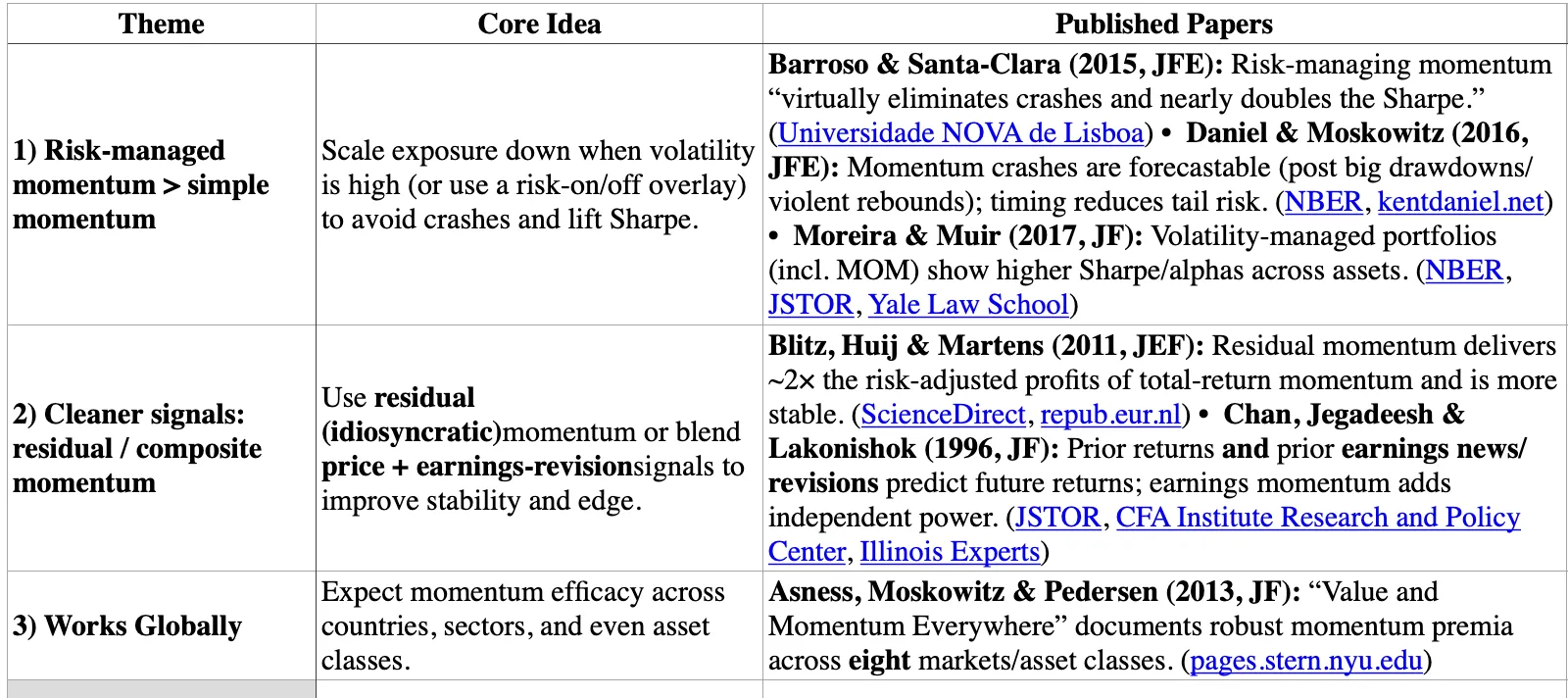
Now lets understand these funds in more details and importantly there key differences
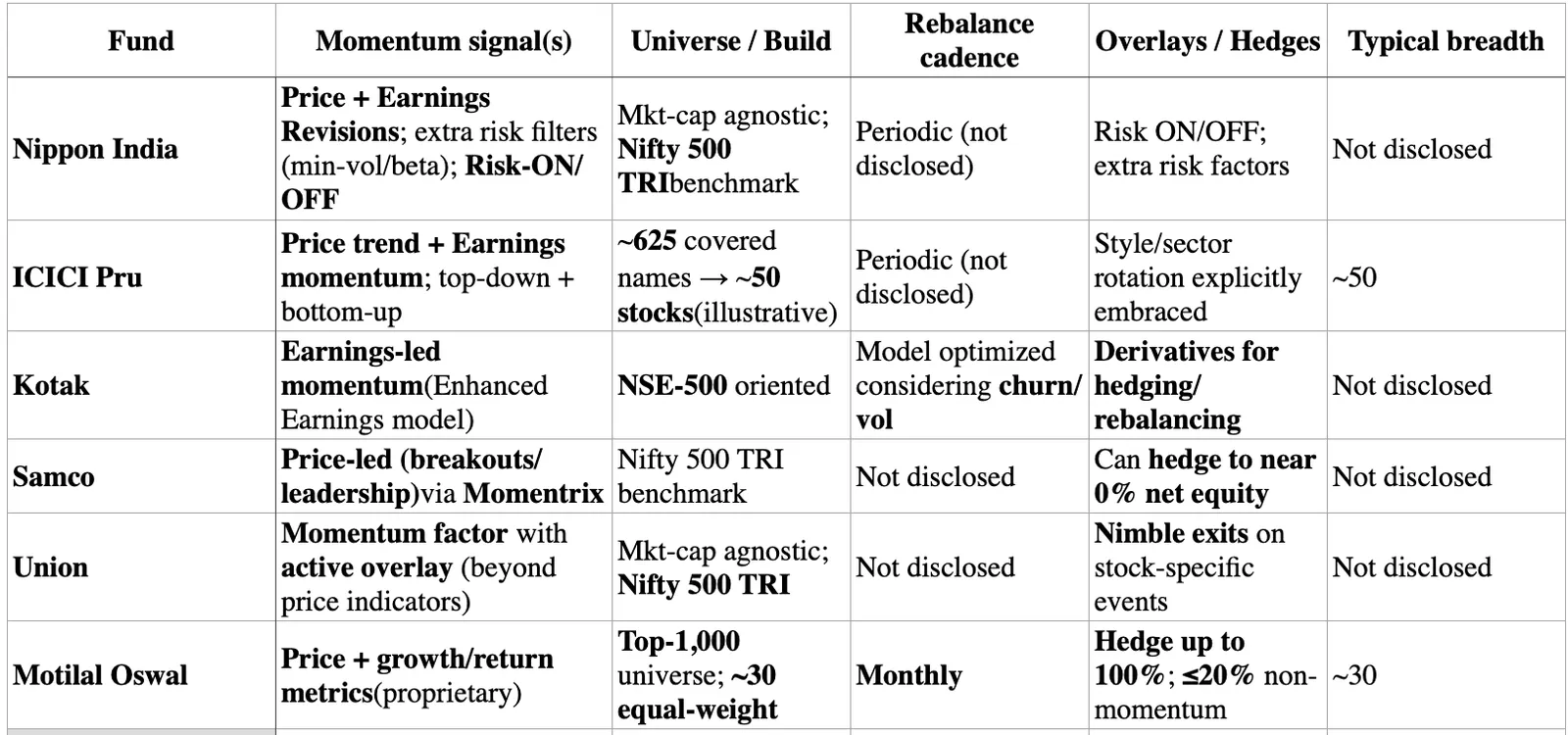
Who is running differentiated strategy?
We used Directional overlap = sum of Fund A’s weights in stocks that Fund B also holds ÷ 100, to come with below
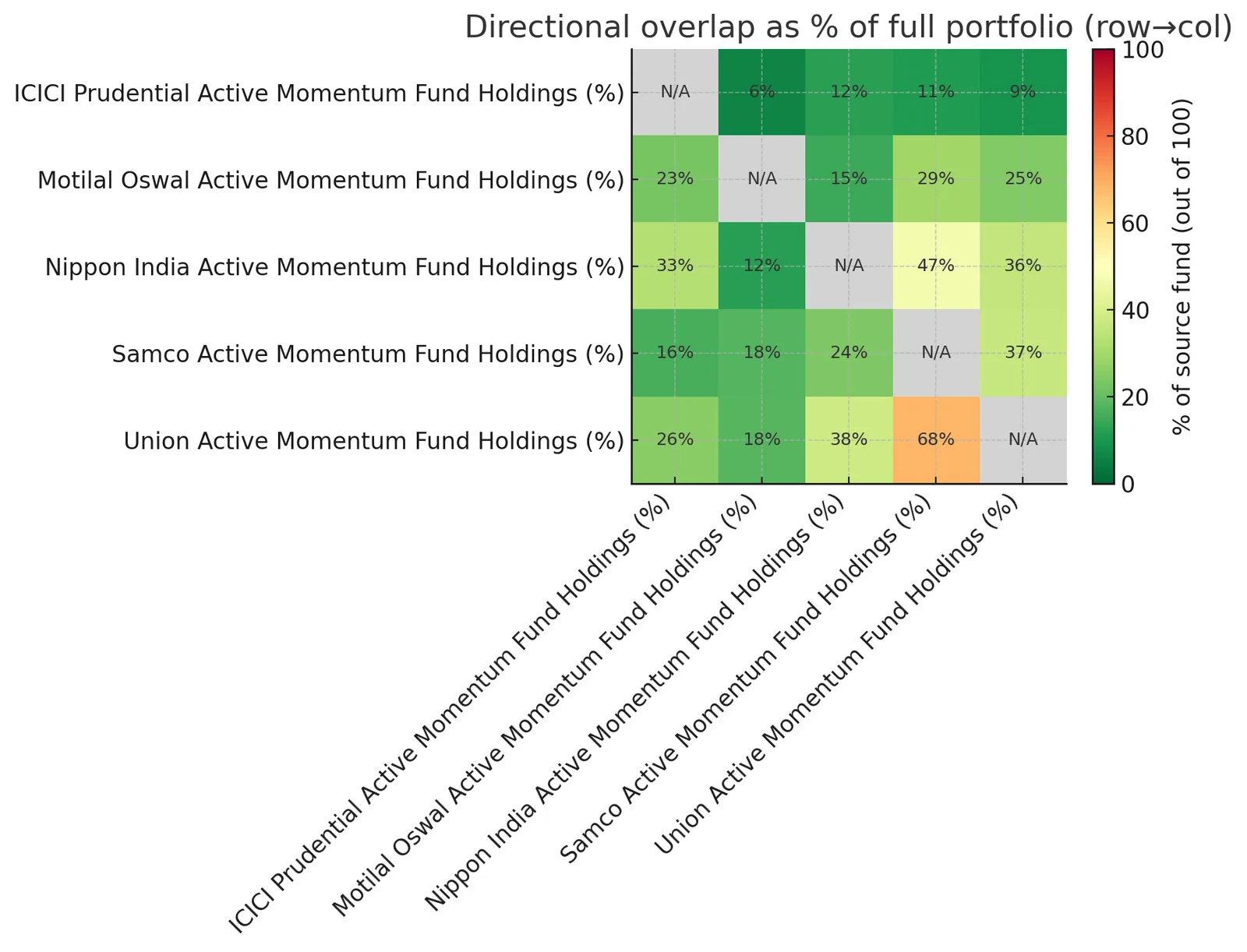
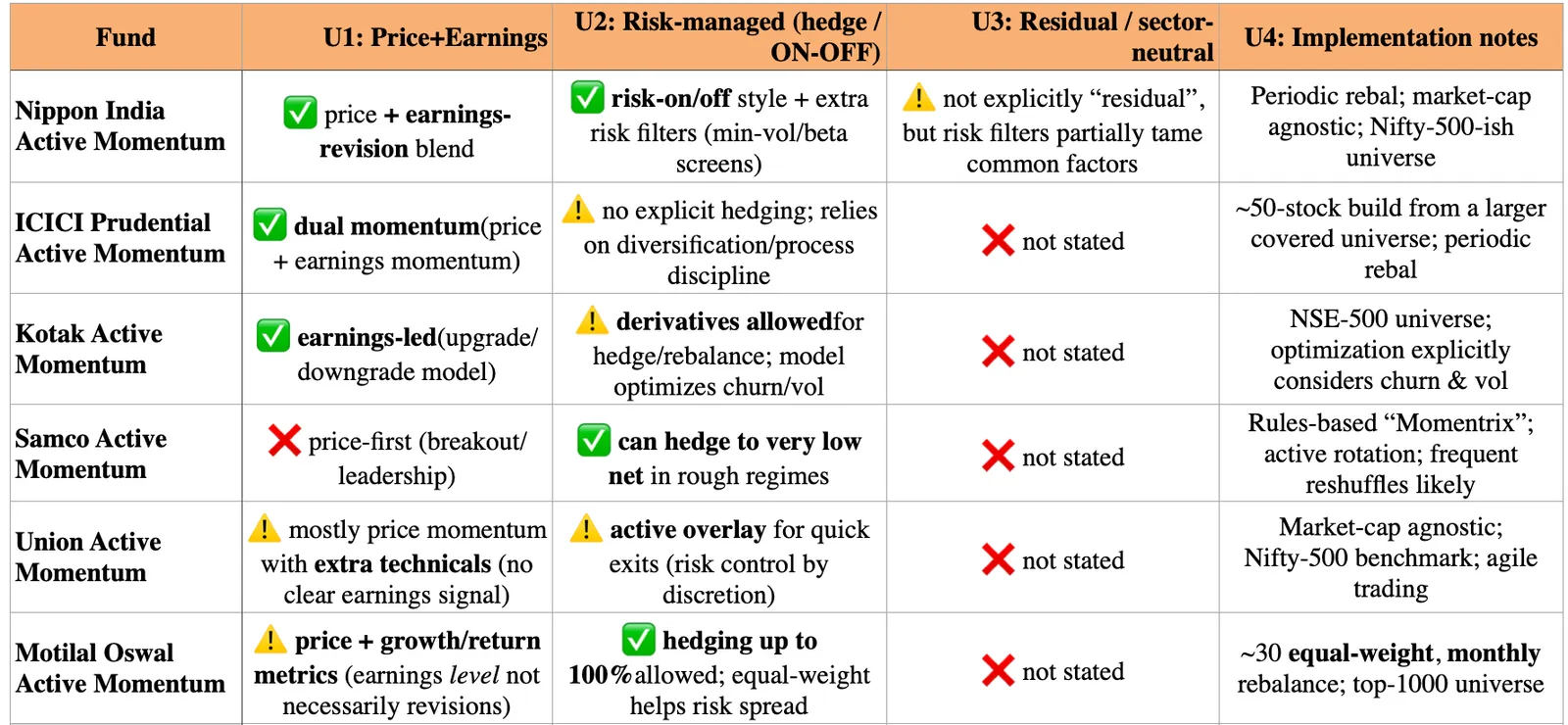
These are early days to read above table ICICI Pru has 6% match with MO Active Fund so most of them except Union Active are running differentiated strategy by looks of it. We also ran each of funds SID document to understand how each on them is stacking against research backed Alpha generation capability
below table highlights that
-
Nippon → Composite momentum (price + earnings revisions) + risk-on/off filters. This lines up with U1 and U2 playbooks from the research.
-
ICICI Prudential → Dual momentum (price + earnings) with a fairly tight basket (~50). That’s a straight U1 upgrade; risk is managed more by diversification than explicit hedging.
-
Kotak → Earnings-upgrade momentum as the primary engine, with derivatives allowed and a model that optimizes churn/vol. That’s U1 plus elements of U2/U4.
-
Samco → Price-led breakout + the ability to dial net exposure down in stress → a clear U2 tilt; less emphasis on U1.
-
Union → Quant price momentum with an active overlay for nimble exits (practical risk control). Partial U2, limited disclosure on U1/U3.
-
Motilal Oswal → Price + growth/return metrics, equal-weight ~30, monthly rebalance, and full hedging flexibility. Strong on U2 and U4; U1 is “partial” unless revisions are explicitly in the model.
How to use this
-
Pick the upgrade you value most.
-
Want sturdier risk/Sharpe? Favor funds with explicit U2 (hedge/ON-OFF) and a steady U4 cadence.
-
Want purer selection edge? Favor U1 (price + earnings revisions) models.
-
-
Cross-check with your overlap matrix.
If two funds both hit U1, make sure you’re not unintentionally cloning the same winners (your new directional %-of-portfolio heatmap is perfect for this). -
Monitor turnover & disclosures.
Look for factsheets/SIDs that evolve to include sector-neutral/residual details (U3). If/when that appears, it’s another academically supported upgrade.
Practical Implementation
One-fund pick (aggressive, 5+ yrs)
Nippon India Active Momentum Fund
- Why: Strong U1 (price + earnings-revision blend) plus a risk-on/off overlay (U2). That’s the combo with the best academic backing for both edge and crash control, while still staying aggressive.
Close alternatives:
-
ICICI Prudential Active Momentum – solid U1 (price + earnings), lighter on explicit risk controls (U2).
-
Kotak Active Momentum – earnings-led U1 with derivatives permitted (partial U2) and optimization for churn/vol (U4).
Two-fund “barbell”
60% Nippon (U1+U2) + 40% Motilal Oswal (U2+U4)
-
Nippon gives selection edge from price + earnings.
-
Motilal Oswal adds explicit hedging up to 100% (U2) and monthly, equal-weight discipline (U4), which historically supports higher Sharpe / smoother ride for a momentum sleeve.
-
This pair typically avoids extreme overlap versus pairing two U1-heavy funds.
What to avoid
- Union ↔ Samco showed very high directional overlap : pairing them won’t buy much diversification. If you already hold one, add a U2/U4-strong fund (Motilal Oswal) rather than the other
We do this type of research before shortlisting funds for client goals no MFD does this!