Aarti Pharmalabs Limited
Company Overview & Business Segments
Aarti Pharmalabs Limited (APL) is a demerged pharmaceutical arm of the Aarti Industries group (spun off in 2022) with a focus on active pharmaceutical ingredients (APIs), intermediates, and contract development & manufacturing (CDMO/CMO) services1. The company operates three main business segments, each contributing roughly one-third of revenues: Xanthine Derivatives, APIs & Intermediates, and CDMO/CMO services2.
APL is India’s largest producer of Xanthine derivatives (caffeine and related compounds) and in fact the only Indian manufacturer in this niche, holding an estimated 15–20% global market share in caffeine supply3.
It meets about 80% of India’s domestic caffeine demand4, making it a strategic supplier to beverage and pharma companies. The remaining two segments leverage Aarti’s chemical expertise in pharmaceuticals: the company has commercialized 55 APIs to date (with a strong presence in high-potency oncology and steroid APIs) and supplies over 500 customers across 50+ countries5.
The API & Intermediates division contributes ~44% of revenue, focused on chronic therapeutic areas like anti-diabetic and anti-cancer APIs, where APL has deep capabilities (including 50+ US DMFs filed and multiple EU CEP certifications)6. Meanwhile, the CDMO segment (13% of revenue in FY252) provides end-to-end custom synthesis for innovator pharma clients, from route development to commercial manufacturing.
APL’s CDMO business specializes in small-molecule NCEs and complex intermediates (including HPAPIs via capabilities like cryogenic reactions and hydrogenation), working with numerous global pharma innovators. This segment has been growing rapidly post-demerging, benefiting from a “China plus one” outsourcing trend and Aarti’s long track record in chemistry services7.
Financial Performance & Growth Drivers
In its first full year as a standalone entity, Aarti Pharmalabs delivered strong financial results. FY2024-25 (FY25) revenues reached ₹2,113 crore, growing ~14% year-on-year, with EBITDA of ₹464 crore (+20% YoY) and net profit ₹272 crore (+26% YoY) for the year8. EBITDA margins expanded to about 22% on the back of higher-margin CDMO contributions and operational efficiencies. Notably, Q4 FY25 was a record quarter (₹564 cr revenue, 26% EBITDA margin), capping the year with momentum8. This growth has been supported by healthy demand across all segments and ramp-up of new projects. The company remains in a phase of heavy investment – in FY25 it deployed ~₹600 crore of capex toward expanding capacities9. Despite this, operating cash flows have remained solid (₹332 cr in FY25), enabling continued funding of growth while also paying dividends.
Cylinder 1
Xanthine Expansion: APL’s Xanthine derivatives business (about one-third of turnover) provides a stable base and cash engine. The Tarapur plant has been running at ~90-95% capacity utilization in recent years, prompting a brownfield expansion. The company is investing about ₹150 crore to increase caffeine and xanthine capacity from 5,000 MTPA to 9,000 MTPA by FY26-FY2710. Management expects strong uptake for the added 4,000 MTPA capacity, targeting 80–90% utilization of the enlarged capacity within 3 years10. Demand drivers include both beverage industry usage (energy drinks, cola manufacturers) and pharmaceutical/nutraceutical grade caffeine (which commands ~20% higher realizations than F&B grade3). The global energy drinks market (~US$75 billion, ~9% CAGR) and a growing domestic pharma market for bronchodilator xanthines underpin volume growth11. With the expansion, APL aims to raise its global market share beyond the current ~15% and better substitute Chinese imports. Analysts project xanthine segment revenues to grow at ~14% CAGR over FY25–27 to reach ~₹1,000 crore by FY27, driven by volume gains11. This provides a steady growth pillar with relatively stable margins (long-term contracts insulate against raw material swings in ~70% of volume).
Cylinder 2
API & Intermediates: The API division (also ~40-45% of revenue) is focused on complex generics and advanced intermediates, particularly in chronic therapies where there is less commoditization. APL has built niche positions in segments like anti-diabetics, cardiovascular, and oncology APIs. For example, it is a leading manufacturer of metformin(anti-diabetic) and various oncology APIs, and has capabilities in high-potency APIs used in oncology and hormone drugs6. Over the years, the company pruned low-margin products and shifted toward higher-value, regulated market opportunities. It now has 11 new APIs in the pipeline under development or validation, many of which are in chronic disease areas like diabetes and cancer6. The strategy is to target upcoming patent expiries of blockbuster drugs (discussed in the Pipeline section below) and be early to market with generic API offerings, as well as to develop advanced intermediates for pharma majors looking to diversify supply from China. In FY25, the API/intermediates segment saw its highest-ever quarterly sales in Q4, with 52% of those sales coming from regulated markets12. This reflects APL’s increased focus on quality-regulated customers (the company holds 58 patents and multiple USFDA/EU-approved facilities). While generic pricing pressure is a constant challenge, APL’s focus on complex and specialty APIs (steroids, anti-cancers, etc.) helps protect margins13. Management indicated they are working on 14+ new products in this segment and expect healthy growth ahead, especially as several go off-patent drugs enter genericization in the next 3–5 years14.
Cylinder 3
CDMO/CMO Upside: The CDMO segment is Aarti’s fastest-growing business, aligned with the global trend of pharma outsourcing. In FY24, CDMO/CMO revenues nearly doubled, and contributed ~18% of Q4 FY24 revenue (and ~27% in Q4 FY25, indicating acceleration)15. APL is engaged with 19 innovator customers on 55 active projects, of which 28 are now in commercial production (the innovator’s drug is on market) and 27 in various development phases (clinical trials)16. This mix is favorable – over half the CDMO projects are already commercialized, providing ongoing revenue streams, while the pipeline of late-stage clinical projects offers future upside.
The Atali project – a new greenfield facility in Gujarat – is a key growth driver here. This ₹300+ crore capex will add ~400 KL of reactor capacity dedicated to CDMO and intermediate manufacturing, effectively doubling APL’s CDMO capacity7.
Mechanical completion occurred in late FY25, with phased commissioning expected through FY26 (full commercialization by end of FY26)17. Once operational, Atali will significantly boost CDMO revenue potential (the company estimates an asset turnover of ~1.3–1.6x for CDMO plants, implying Atali could eventually generate ₹500–600 cr annual revenue at full utilization). Even ahead of Atali’s contribution, management has guided for 30–40% YoY growth in CDMO revenue in FY2618, on the back of strong order inflows from existing projects. Over the medium term, APL targets ~20–25% annual growth in the CDMO segment718, which appears achievable given the robust project pipeline and the global outsourcing tailwinds.
Notably, ~90% of Aarti’s CDMO business is with innovator pharma (rather than generic companies), indicating sticky, long-term contracts if APL delivers on quality and scale7.
This segment also carries superior margins (CDMO projects helped lift consolidated EBITDA margin above 20% in FY24-25). Together with the expanded xanthine business, the high-margin CDMO ramp-up is expected to be the primary driver of margin expansion going forward.
Industry Position & Tailwinds
APL sits at the intersection of two favorable industry trends: (1) the patent cliff-driven opportunity in complex generics, and (2) the increased outsourcing by global pharma (especially for specialty chemicals and drug substance). Between 2025 and 2030, the pharmaceutical sector faces an unprecedented wave of drug patent expiries (an estimated >$200 billion in branded sales are going off-patent by 2030). This presents a huge opportunity for API suppliers who can develop cost-effective processes for these molecules. Aarti Pharmalabs has explicitly aligned its R&D towards “new molecules with patent expiry in the next 3–5 years”14, aiming to capture the first-mover advantage in supplying their APIs and key starting materials once generics are allowed. Many of the APIs under development at APL fall into this category (e.g. novel anti-diabetes and oncology drugs that will lose exclusivity by 2025–28 – detailed in the next section). By leveraging its strong process chemistry expertise and regulatory filings, APL is positioning to serve regulated generic markets for these blockbusters.
At the same time, global pharma and biotech firms are increasingly outsourcing chemical development and manufacturing to reliable partners, a trend accelerated by supply-chain diversification (the “China+1” dynamic) and cost pressures. India, with its skilled talent pool and significantly lower cost base, has emerged as a preferred location for outsourcing R&D and manufacturing19. Aarti Pharmalabs, being an established player with USFDA-approved facilities, is benefiting from this secular shift. The cost advantage is notable – wage and production costs in India are a fraction of Western markets, yielding 30–50% cost savings for innovators who partner with Indian CDMOs19. Moreover, India’s stricter enforcement of IP protection in recent years has improved Western clients’ confidence in shifting projects to Indian vendors. APL’s long history as part of Aarti Industries (a respected name in specialty chemicals) and its Gold-rated quality systems (e.g. recent EcoVadis Gold rating) further strengthen its credibility. The company’s CDMO client list (16+ innovators including big pharma) and repeat business indicate that APL is becoming an integral part of these clients’ supply chains. Additionally, within India, import substitution opportunities (especially replacing Chinese suppliers for intermediates/KSMs) provide another growth lever. APL has noted that many of its CDMO projects involve supplying regulated starting materials where customers seek to reduce over-reliance on China15. Government incentives (such as India’s PLI scheme for key pharma intermediates) and the push for supply chain resilience globally both play into Aarti’s strengths in custom synthesis.
Overall, Aarti Pharmalabs is emerging as a unique CRAMS (Contract Research and Manufacturing Services) play with a diversified model. It has a stable cash-generative business (caffeine/xanthines) and a high-growth engine (CDMO) with significant operating leverage. The company’s integrated approach – from intermediates to APIs to NCE development – allows it to capture value across the pharma value chain. As it executes ongoing expansions, APL is poised to scale up revenues and improve return ratios (ROCE was ~18% in FY24 and likely to rise as new capacities sweat15). Analysts forecast a 16% CAGR in revenues over FY25–27 for APL, with topline reaching ~₹2,700 crore by FY27 and margins inching upward20. If achieved, this would outpace many traditional generic API peers. The stock’s valuation (around 23–25x FY25 earnings) already reflects some of this optimism, but continued delivery on growth could warrant further re-rating.
Pipeline of Upcoming Molecules & Custom Synthesis Opportunities
One of the most exciting aspects of Aarti Pharmalabs’ story is its pipeline of upcoming molecules in development, both as future generic APIs and as part of CDMO partnerships. The company’s R&D is actively targeting numerous high-value drugs that are nearing patent expiry or are in clinical development with its clients. Successfully capitalizing on these opportunities could unlock significant revenue streams for APL in the coming years. Below we provide a comprehensive analysis of key molecules in APL’s pipeline, including their therapeutic area, market size, development status, timeline to commercialization, and estimated revenue opportunity for APL.
Focus on Patent Cliff APIs (Next 3–5 Years)
APL’s strategy is clearly geared towards the imminent patent cliff. Management has stated a focus on molecules going off-patent by 2025–203014. In practice, this means APL is developing processes and filing Drug Master Files (DMFs) for a host of drugs whose branded sales are in the billions of dollars. Many of these are in oncology and diabetes – therapeutic areas where Aarti already has expertise and where upcoming generic competition is expected to be intense. By preparing early (sometimes years in advance of patent expiry) with process validation and regulatory filings, APL aims to be among the first wave of API suppliers when generic markets open.
Notable near-term opportunities include: Dapagliflozin (brand Farxiga, for diabetes/heart failure) – a $7.7 billion drug in 2024 whose main patents expired in 202521; Ticagrelor (Brilinta, antiplatelet) – a $1.3 billion cardiovascular drug, losing exclusivity around 2024/2522; Tofacitinib (Xeljanz, immunology) – a rheumatoid arthritis therapy ($2B peak sales) going generic by 202623; and Vortioxetine (Trintellix, antidepressant) – an CNS drug (~$1 billion market) with U.S. patents expiring in 202624. Aarti has been working on all of these: in fact, its pipeline list shows DMFs under preparation or validation for dapagliflozin, ticagrelor, tofacitinib and vortioxetine slated by 202525. This implies APL will be ready to supply these APIs in regulated markets as soon as generics are approved. Dapagliflozin, in particular, is a massive opportunity – the drug’s 2024 sales of $7.7bn make it one of the largest patent-cliff drugs; generic competition from late 2025 could create a multi-thousand-crore global generic market21. If Aarti can capture even a modest share (for instance, by partnering with major generic formulators), the revenue uplift could be substantial (potentially ₹200–300+ crore annually from dapagliflozin alone at peak generic penetration, given the size of the pie). Ticagrelor’s generic entry in 2025 will similarly open up demand for its API – while a smaller market, it could still add meaningful volumes (Brilinta peaked at ~$1.6bn sales globally)22. For tofacitinib and vortioxetine, which will see generic launches around 2026, APL’s readiness positions it well to win contracts from generic drug makers. These are smaller markets than the above, but each could contribute incremental growth in FY27 onward. The key for Aarti will be securing customer wins for these APIs; early DMF filing and proven quality/capacity often give an edge in being selected as a supplier.
Mid-Term Launches (FY27–FY29): Oncology Blockbusters
The next wave of APL’s pipeline centers on oncology drugs that lose exclusivity in the latter part of this decade (2027–2030). Oncology is a core focus for Aarti – it already produces several oncology APIs (and has specialized facilities for highly potent compounds). The pipeline features multiple cutting-edge cancer therapies: for example, Apalutamide(Erleada for prostate cancer, ~$2 billion sales in 2022 and growing26) has a patent cliff around 2028, and APL is validating its process (European DMF validation expected by 2025)25. Apalutamide’s market is forecast to reach ~$6 billion by 2033 as usage expands26, so a timely generic launch (Day-1 launch in key markets) could yield a significant revenue opportunity – potentially on the order of ₹100+ crore annually for APL if it secures major generic supply contracts, considering the size and growth of this market. Similarly, Olaparib (Lynparza, a PARP inhibitor for ovarian/breast cancer) is a ~$2–3 billion drug whose US patents begin to expire in 2027–2827. Aarti plans an EDMF for Olaparib by 202525, aiming to be ready for generic demand by 2028. Lynparza is expected to remain a dominant therapy through the decade (projected ~$4bn sales by 2028) until generics arrive27; thus, APL’s early mover preparation could translate into another sizable stream of business post-2028.
Another high-profile molecule is Ruxolitinib (Jakafi, for rare blood cancers) – a ~$3 billion drug (2022 sales) facing patent expiry in 202828. APL lists ruxolitinib as “under research” in its pipeline25. Given Jakafi’s importance (it’s Incyte’s flagship drug), multiple players will target its generics; however, Aarti’s capabilities in handling complex APIs (ruxolitinib is a JAK inhibitor) and capacity coming online at its new plants could make it a preferred supplier. Ribociclib(Kisqali, breast cancer, $2.4B sales in 202429) is another oncology API APL is researching – though its patent runs longer (to 2031+ in US29), an earlier entry in certain markets or partnering for authorized generics could be possibilities. Venetoclax (Venclexta, leukemia) is yet another notable pipeline molecule (global sales ~$1.2B in 202430, patents till ~203230); Aarti has it in validation for 202525. While venetoclax generics are farther out timewise, APL’s work now might be tied to a CDMO partnership – possibly producing this API for the innovator or as part of a tech transfer, since AbbVie (the innovator) has sought to extend its patent and might engage external suppliers for cost reduction. All these oncology products, if and when they convert to generic status, represent multi-billion dollar markets – even a single-digit percentage share for Aarti as an API provider can translate to hundreds of crores in revenue. The timeline for revenue realization will vary: apalutamide and olaparib could start contributing by FY28–29; ruxolitinib around FY29; venetoclax and ribociclib likely only post-2030 unless early opportunities arise (e.g., emerging market tenders or second-source supply to the incumbents).
It’s worth noting APL also develops some older oncology APIs (like bicalutamide, ifosfamide, mesna, etc.13) which are already generic – these provide steady business but limited growth. The big delta will come from the newer, large-volume drugs discussed above.
Long-Term Pipeline & CDMO Projects
Looking beyond 2030, Aarti Pharmalabs’ pipeline includes a few heavyweights such as Osimertinib (Tagrisso, a $6.6 billion/year lung cancer drug31) – APL lists this as “under research,” indicating very early work, as Tagrisso’s main patents extend to 2032–33. While it’s far off, laying the groundwork now (process know-how, non-infringing routes, etc.) could position APL to capture this opportunity when it eventually opens. The same goes for future CDMO molecules: APL’s CDMO pipeline is inherently tied to the fate of its customers’ drugs in clinical trials. As of FY25, the company had 27 projects in clinical development stages with clients16. These span all phases (Phase I, II, III), with a skew toward later-stage (the company indicated a significant number in Phase III/NDA stage, reflecting high probability of approval)16. For Aarti, if even a handful of these partner molecules succeed and get commercialized, it can secure long-term manufacturing contracts (often exclusive or primary supplier status) which would add materially to revenue. For example, if an innovator’s novel therapy for which Aarti is manufacturing the API gets approved, APL stands to benefit from the commercial supply ramp-up of that drug. Management has noted that many of the 33 commercial CDMO projects are already supplying launched innovator drugs, and APL often serves as either a primary or secondary supplier to those pharma companies16. In cases where APL is initially a second source, it has the opportunity to displace incumbents by proving reliability and cost advantage, thereby scaling its share of that molecule’s supply16.
Because of confidentiality, APL doesn’t disclose the names of most CDMO molecules, but their therapeutic areas likely align with Aarti’s strengths (oncology, anti-diabetic, etc.). It’s reasonable to assume some could be NCEs for specialty diseases or advanced intermediates for big pharma’s pipeline drugs. While the success of any given project is uncertain (industry average success from Phase II to approval is under 30%16), Aarti’s broad base of 20+ late-stage projects diversifies this risk. The lead time in CDMO is also such that APL usually has ~1-2 years of visibility on major projects before commercialization14. The company can thus prepare capacity and scale in advance. Management expects the CDMO segment to keep a high growth trajectory (30% CAGR near-term18), indicating confidence that multiple projects will contribute. In financial terms, APL’s CDMO revenue was ~₹200+ crore in FY24 and is on track for ₹300+ crore in FY26E20; by FY27–28, this could easily exceed ₹400 crore if the pipeline conversion is strong20. Table 1 below summarizes key known pipeline molecules for Aarti Pharmalabs, along with their market sizes and potential timeline:
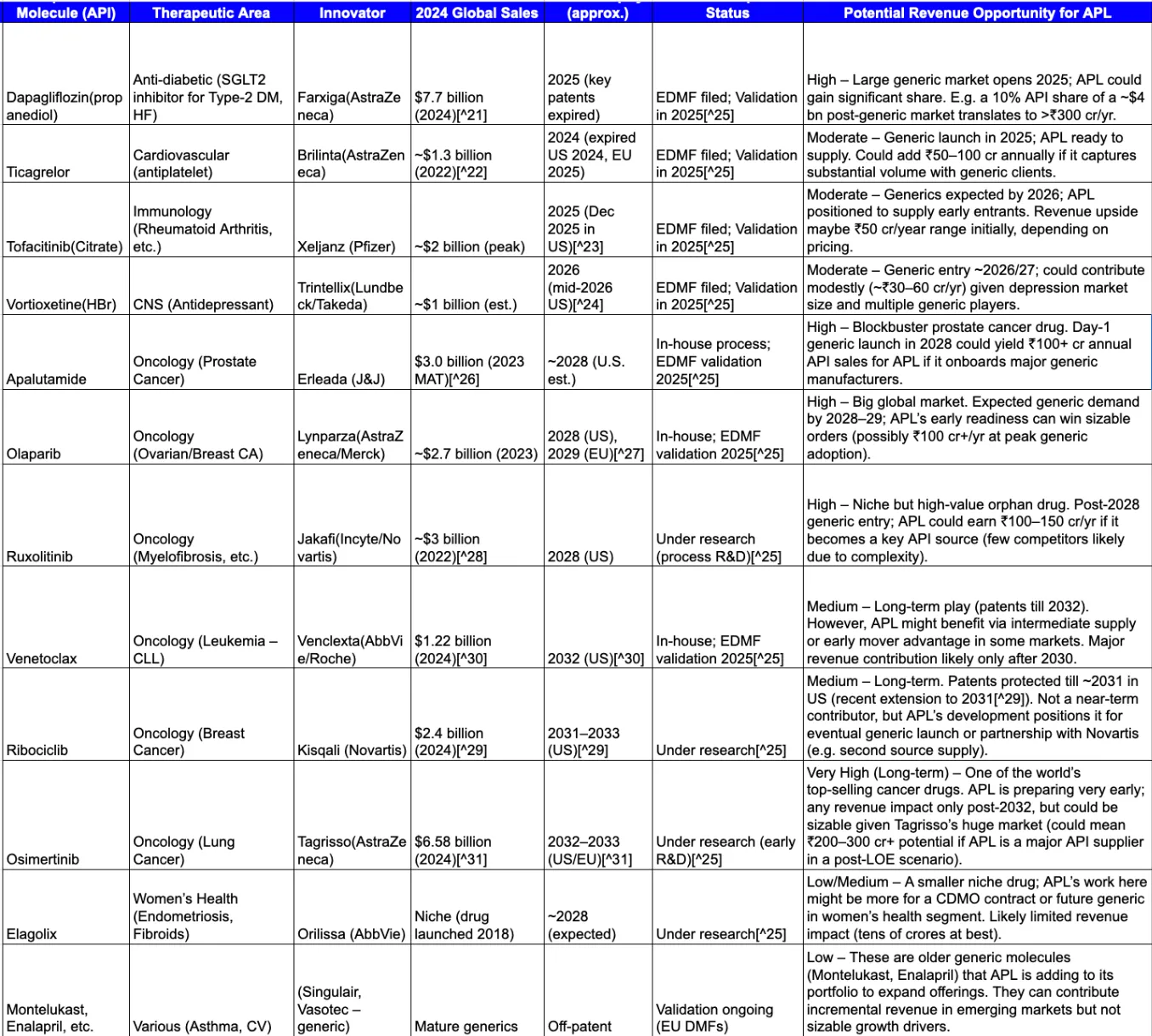
Table 1: Key Pipeline Molecules for Aarti Pharmalabs – Market Size and Status. Sources: Company pipeline disclosures and industry sales data.
As shown above, Aarti’s pipeline is rich and spans multiple therapeutic areas, primarily dominated by anti-cancer and metabolic disorder drugs. The commercial market sizes range from a few hundred million dollars (niche drugs) to multi-billon blockbusters. APL’s development status (as of FY25) indicates that many of these projects are at an advanced stage of process development, with regulatory filings (DMFs/EDMFs) timed around 2024–25 for those expiring by 2025–28. This timing is critical – it suggests Aarti intends to be ready with validated processes roughly 1–3 years before patent expiry, aligning with the timeline generic companies need to prepare ANDAs. In some cases, APL may even launch in India or other markets earlier if patent constraints are region-specific (for instance, Indian patent laws sometimes allow earlier entry for local companies if no patents exist locally).
It’s also notable that several pipeline targets (e.g. venetoclax, ribociclib) have patents later in the decade, yet APL is working on them now. This could indicate custom synthesis contracts – i.e., Aarti might already be producing these under contract for the innovators (or their licensees) as a second source. In fact, APL management hinted that in the commercial CDMO projects, some are cases where APL is a secondary supplier trying to take on volumes from the primary source16. For example, APL could be making venetoclax or apalutamide API for the innovator in smaller quantities to prove its capabilities; later, post-patent expiry, the same expertise could be used to supply the generic market. This dual approach (serving innovators now, and generics later) maximizes the revenue lifecycle of APL’s process R&D efforts.
In terms of estimated revenue opportunity for APL: if we aggregate the major molecules (dapagliflozin, apalutamide, olaparib, ruxolitinib, osimertinib, etc.), the potential is enormous – likely well over ₹500–600 crore annually by FY30+
if APL can capture respectable shares in each. Of course, this is a best-case scenario; actual outcomes will depend on competition, pricing erosion, and regulatory approvals. The generic API business can be very competitive, so APL will face Indian peers (Divi’s etc.) and Chinese players in bidding for these opportunities. However, the sheer scale of the markets means even with competition, there is room for multiple winners. Aarti’s advantages include its backward integration (many raw materials are sourced internally or through its chemical sister companies) and a proven ability to handle complex chemistries, which should give it an edge in high-barrier APIs. Analysts haven’t yet broken out revenue forecasts by molecule, but they generally bake in accelerating API segment growth in the coming years – e.g., expecting the API/Intermediates division to grow in mid-teens CAGR as new products commercialize20. This implicitly assumes a few of these pipeline launches succeed.
The CDMO side of the pipeline is harder to quantify (due to confidentiality of molecules), but management’s 30–40% growth guidance for FY26 suggests at least a few late-stage client projects are ramping up to commercial scale18. If one of those is a significant drug (for instance, a new therapy for which APL is a primary producer), it could itself contribute tens of millions of dollars in revenue at peak.
In summary, Aarti Pharmalabs’ pipeline strategy is to plant many seeds – some via generic API developments aimed at the patent cliff, and some via custom synthesis for innovators – knowing that not all will bear fruit, but a handful could turn into major revenue trees. The pipeline is well-aligned with global pharma trends (diabetes, oncology remain high-growth therapeutic areas) and leverages APL’s core strengths. Investors should watch for milestones such as DMF filings (an indication of nearing commercialization) and any announcements of large supply agreements. The next 2–3 years (FY26–28) will be critical to see how many of these pipeline projects translate into actual sales. Encouragingly, APL’s proactive approach and early investments in R&D increase the probability of success.
Risks & Considerations
While Aarti Pharmalabs offers a compelling growth narrative, investors should be mindful of several risks and challenges:
-
Execution & Scale-up Risk: The company is in the midst of large capex projects (new plants, capacity expansions) that must be executed on time and on budget. Any delays or bottlenecks (for instance, the Atali CDMO plant commissioning was slightly pushed from Q1 FY26 to late FY2616) could defer the anticipated revenue ramp-up. Similarly, scaling up from lab to commercial scale for new molecules can pose technical challenges. Ensuring consistent quality at larger volumes (especially for regulated markets) will be crucial.
-
Regulatory and Compliance Risk: Operating in the pharmaceutical supply chain means strict regulatory oversight. APL’s facilities are subject to USFDA, EU GMP and other inspections. Any compliance lapse or warning letter could disrupt production and tarnish its reputation. So far, Aarti has a good track record with regulators, but this must be maintained as it adds new plants and products. Moreover, obtaining timely approvals for its DMFs and products is a dependency – regulatory delays can slow its market entry for generics.
-
Market Competition & Pricing: Many of the opportunities APL is chasing (patent-expired APIs, CDMO contracts) are or will be competitive. Other Indian API firms are also targeting the same big patent-cliff drugs, and global players may compete on price. Generic API pricing tends to erode rapidly – often dropping 50–80% within a couple of years of generic entry21. If too many suppliers enter, APL’s volume share or margins might be lower than expected. On the CDMO front, competition comes from both domestic peers and global CRO/CDMOs. There is also the risk that an innovator might discontinue a project or switch vendors. In fact, loss of a CDMO contract is not uncommon in this industry if a project is shelved or if the client is acquired31. Aarti mitigates this by having 50+ projects, but a few larger ones likely account for a big portion of CDMO revenue, so any sudden loss there would impact growth.
-
Dependence on Key Products/Customers: Currently, APL’s revenue mix, especially in APIs, has some concentration. For example, its top 5 API products in exports contributed ~70% of API revenue in FY2532. In xanthine, caffeine is the dominant product (majority of xanthine revenues)3. This reliance means any downturn in demand or pricing for those key products (or loss of a key customer order) could significantly hit earnings. As APL diversifies with new launches, this concentration should reduce, but in the near term it remains a consideration. Similarly, on the CDMO side, a handful of customers/projects drive business – the loss or delay of a big project (e.g., a Phase-3 failure of a client’s drug) would slow the trajectory.
-
R&D and Pipeline Risk: Aarti’s aggressive pipeline rollout comes with the risk that not all projects succeed technically or commercially. The company is expending R&D resources on many molecules; some might face patent litigation (if APL’s process is challenged by innovators) or could become less attractive if the branded drug’s sales decline (for instance, due to a new better drug in that indication). There’s also the uncertainty inherent in innovator pipelines – about half of APL’s CDMO projects are in development phase, where success is far from guaranteed. Industry statistics show only ~30% of drugs in Phase II advance to Phase III, and ~58% from Phase III to approval16. If a number of those fail, APL would need to replace them with new projects to meet its growth targets.
-
Macro & Forex Factors: Being an exporter (~52% of FY25 sales were international5), Aarti faces foreign exchange fluctuation risk. A stronger rupee could impact realizations. It also imports certain raw materials (though many are backward integrated or sourced from domestic suppliers within the Aarti group). Global macro conditions can affect order flow – for instance, a slowdown in end-market demand or funding crunch for biotech (as seen in 2022–23) can temporarily reduce CDMO project spend. Geopolitical factors (trade policies, China supply issues) can cut either way – they might benefit Aarti via more business, or cause volatility in input costs.
-
Working Capital & Financial Risk: Rapid growth in CDMO and new product launches will require working capital (inventory buildup, credit to customers) and could strain the balance sheet if not managed well. Thus far APL has maintained a reasonable debt level and healthy cash flow, but any misstep in execution could change that profile. The company’s return ratios are improving but still modest (ROE ~12–13%7) given the heavy capex; investors expect those to rise as projects stabilize, so any underperformance could affect market sentiment.
Despite these risks, Aarti Pharmalabs appears to be handling them proactively – by diversifying its project portfolio, securing long-term contracts where possible, and leveraging the larger Aarti group’s resources (for raw materials and infrastructure). It also helps that APL’s businesses have some natural hedge: the stable xanthine and established API revenues can support the more variable CDMO/projects business in lean times. Investors should monitor developments such as the timely completion of the Atali plant, regulatory audit outcomes, and the progress of key pipeline launches (e.g., whether APL is among DMF filers for major drugs like Farxiga or Erleada as patents expire).
Conclusion & Investment Outlook
Since its listing as an independent company, Aarti Pharmalabs has positioned itself as a promising Pharma/CRAMS player with multiple cylinders of growth. The company combines a steady cash-generating base (caffeine/xanthines, mature APIs) with high-growth verticals (custom synthesis for innovators and new high-value generics). This balanced model provides both defensiveness and growth optionality – a desirable mix for investors. The deep-dive above illustrates that APL is not resting on the legacy business; it is aggressively expanding capacity and investing in future molecules. The potential payoff from its pipeline (both generic and CDMO) could be game-changing, potentially propelling the company into a higher revenue league by the end of the decade if key molecules materialize. There is evidence of execution capability: in FY25 Aarti hit record profits and margins, and management’s guidance of 12–15% EBITDA growth for FY26 (despite macro challenges) underscores their confidence16.
Valuation-wise, the stock’s rerating over the past year (partly driven by strong results and increasing FII interest) means it is no longer a deep value play; at ~25x earnings the market is baking in the growth trajectory.
For further upside, APL will need to deliver on its earnings CAGR of mid-teens (or higher). On that front, the outlook appears positive – the ramp-up of the new capacities (9000 MTPA caffeine by FY27, new CDMO blocks) and the launch of products targeting large markets could collectively drive a higher growth rate than the conservative guidance.
If CDMO surprises on the upside (say 40%+ CAGR) and a couple of big API wins land by FY27, Aarti’s earnings could compound much faster. Additionally, any strategic moves – such as a tie-up with a big pharma for a long-term supply, or monetization of its extensive patent portfolio (58 patents filed5) via licensing – could add value.
Approach Aarti Pharmalabs with a long-term perspective. The story is fundamentally about capturing opportunities in a rapidly evolving pharma landscape, which won’t happen overnight but over several years of consistent execution. There will likely be volatility –> quarterly numbers may swing as CDMO orders are inherently lumpy and as generics pricing can fluctuate. The key is the trajectory: if APL continues to hit milestones (e.g., Atali commissioning, successful DMF approvals, 25+% CDMO growth, etc.), it strengthens the investment thesis. As with any pharma/CRAMS stock, keeping an eye on quality metrics (regulatory compliance, client diversity, R&D spending) is crucial, as these are leading indicators of sustainability.
The upcoming years hold significant promise – the company could potentially double its revenues by FY28–29 if things go right, driven by the confluence of its three growth engines. Yet, prudence is warranted given execution and industry risks. Investors may take comfort in the fact that APL’s management (largely from the promoter Gogri family) has successfully scaled businesses before (as seen with Aarti Industries in specialty chemicals). If Aarti Pharmalabs can replicate that success in the pharma domain, the stock could deliver healthy returns.
Thinking long-term, focusing on fundamental progress (new product launches, client wins), and being mindful of the risks will be key. Overall, APL offers a unique blend of stability and high-growth potential – a rarity in the pharma mid-cap universe making it a stock to watch in the coming patent cliff super-cycle.
Note this is not investment advise, this post was written to expand my knowledge on subject, I am long on company’s stock and may change my position any time
Footnotes (Sources):
Footnotes
-
In 2022, Aarti Industries’ pharmaceuticals division was demerged into a separate entity, Aarti Pharmalabs (APL), to unlock operational efficienciesicicidirect.com. APL is engaged in manufacturing Xanthine derivatives, APIs (including high-potency APIs), intermediates, and also operates as a CDMO provider.icicidirect.com ↩
-
APL’s business is split across three verticals – Xanthine Derivatives (~44% of revenue), API & intermediates (~44%), and CDMO services (~13%)icicidirect.com. (Figures as of FY24–25; the mix may shift as CDMO grows.) ↩ ↩2
-
Aarti Pharmalabs is the only Indian company with the capability to manufacture Xanthine derivatives at scale, commanding about a 15–20% share of the global market for these productsicicidirect.com. The Xanthine segment (caffeine, theophylline, etc.) has historically been a core business for APL. ↩ ↩2 ↩3
-
The company caters to roughly 80% of India’s domestic caffeine requirementicicidirect.com, making it the dominant local supplier of caffeine (a key Xanthine derivative) for beverages and pharma use in India. ↩
-
APL serves over 500 global customers across 50+ countries and has built a broad portfolio – it has filed 58 patents, 50 US DMFs (Drug Master Files), and obtained 31 Certificates of Suitability (CEPs) for various productsicicidirect.comicicidirect.com. Since inception, the company has commercialized 55 APIs, including many in complex therapy areas like oncology and corticosteroidsicicidirect.com. ↩ ↩2 ↩3
-
Aarti’s API & Intermediates division focuses on chronic therapeutic areas. The company has a strong presence in anti-diabetic APIs (metformin, etc.) and anti-cancer APIs, among others. Over the years APL has developed 55 commercial APIs and currently has 11 new APIs under development or validationaartipharmalabs.com. It specializes in high potent APIs (HPAPIs) used in oncology and hormone treatments, which are less competitive and command better marginsvaloremadvisors.com. ↩ ↩2 ↩3
-
Industry Tailwind: Indian CDMOs have gained favor due to cost advantages and improved capabilities. Indian CDMO players offer significantly lower cost bases – e.g., wage costs much lower than in Western countries – and comply with global quality standards, making them attractive outsourcing partnersvaloremadvisors.comvaloremadvisors.com. Additionally, Aarti’s strategic positioning aligns with the “China+1” trend, as global pharma looks to diversify supply chains away from sole reliance on Chinavaloremadvisors.com. ↩ ↩2 ↩3 ↩4 ↩5
-
FY25 Financials: APL reported ₹2,113 crore revenue for FY2024-25, up ~14% YoY, with quarterly Q4 FY25 revenue at ₹564 cr (+11% YoY)stockdiscovery.s3.amazonaws.com (link now broken). FY25 EBITDA was ₹464 cr (20% growth YoY), and PAT ₹272 cr (up 26% YoY)stockdiscovery.s3.amazonaws.com (link now broken)stockdiscovery.s3.amazonaws.com (link now broken), reflecting margin expansion (annual EBITDA margin ~22%). Q4 FY25 PAT was ₹88 cr (+35% YoY), the highest ever quarterly profitstockdiscovery.s3.amazonaws.com (link now broken). ↩ ↩2
-
The company undertook ~₹600 crore of capital expenditure in FY25 for various growth projectsforum.valuepickr.com, including a brownfield expansion of xanthine capacity (from 5000 to 9000 MTPA) costing
₹130–180 cr and the new greenfield API/CDMO plant at Atali (₹300+ cr)forum.valuepickr.comforum.valuepickr.com. These investments are expected to drive growth from FY26 onward. ↩ -
APL is expanding its Xanthine derivative manufacturing capacity by 4,000 MTPA (to reach 9,000 MTPA total) through a brownfield project, expected to complete by FY26/27icicidirect.comicicidirect.com. Management anticipates achieving ~80–90% utilization of the expanded capacity within 3 years of commissioning, given strong demand in pharma and beverage segmentsicicidirect.comicicidirect.com. ↩ ↩2
-
The energy drink and functional beverage market (major consumer of caffeine) is around $75 billion globally and growing ~9% CAGRicicidirect.com. In India, the Xanthine derivatives market is projected to reach ~5,500 MTPA by FY27 (9% CAGR), with particularly high growth in theophylline (17–18%) and continued growth ~7–8% in caffeine demandicicidirect.comicicidirect.com. This robust demand backdrop underpins APL’s Xanthine expansion, and analysts forecast APL’s Xanthine segment revenues to grow at ~14% CAGR (FY25–27E) to ~₹1005 crore by FY27icicidirect.com. ↩ ↩2
-
In Q4 FY25, the API & intermediates segment contributed ~39% of Aarti’s turnover (its highest-ever quarterly sales for this segment)stockdiscovery.s3.amazonaws.com (link now broken). Within that, about 52% of API sales were to regulated markets (US, Europe etc.), reflecting the company’s focus on higher-value marketsstockdiscovery.s3.amazonaws.com (link now broken). The company indicated strong traction in chronic therapies APIs like anti-diabetics, cardiovascular, and oncology. ↩
-
APL has managed to sustain healthy API segment margins despite pricing pressure by focusing on high-value products (steroids, oncology APIs) which are less crowded and yield better profitabilityvaloremadvisors.com. It has also strategically phased out low-margin APIs and optimized its product mix to favor complex, return-accretive productsvaloremadvisors.com. Multi-purpose plants and backward integration further help in cost efficiencyvaloremadvisors.com. ↩ ↩2
-
Management Statement – Product Innovation: Aarti is “continuously working towards product innovation and focusing on new molecules with patent expiry in the next 3 to 5 years”stockdiscovery.s3.amazonaws.com (link now broken), particularly in the API segment. This indicates a clear strategic intent to target upcoming patent cliffs by developing generic APIs ahead of time. ↩ ↩2 ↩3 ↩4
-
CDMO Segment Growth: As of Q4 FY24, APL was working with 16 customers on 40 CDMO projects (21 of which were commercial)forum.valuepickr.com. By Q2 FY25, this increased to 19 customers and 55 projects (28 commercial)valoremadvisors.comvaloremadvisors.com. The CDMO/CMO business nearly doubled in FY24 and management expects ~30–35% annual growth going forward, as indicated in conference callsforum.valuepickr.com. Gross margins in this segment are high (~50%+), contributing significantly to APL’s overall margin improvementforum.valuepickr.comforum.valuepickr.com. ↩ ↩2 ↩3
-
As of Q2 FY25, APL had 55 CDMO projects with 28 in commercial stage and 27 in various development stagesvaloremadvisors.com. Roughly half the molecules are already commercialized by the innovator, meaning APL is generating revenue from them. The remaining pipeline projects are spread across clinical phases. Industry success rates by phase: only ~28.9% of projects advance from Phase II to III, while ~90.6% of those reaching the NDA/BLA (regulatory filing) stage get approvedvaloremadvisors.comvaloremadvisors.com. APL’s distribution of projects (with many in late-stage) tilts the odds in its favor, but some attrition is expected. Notably, management indicated they serve as both primary and secondary supplier across different projects; even as a second source, they have positioned themselves to capture business by offering a reliable alternative to the innovator’s main supplierstockdiscovery.s3.amazonaws.com (link now broken)stockdiscovery.s3.amazonaws.com (link now broken). ↩ ↩2 ↩3 ↩4 ↩5 ↩6 ↩7 ↩8 ↩9↩10
-
The Greenfield Atali plant (Gujarat) is a major expansion for Aarti aimed at the CDMO and intermediate business. It will add over 400 KL of reactor capacity and was initially guided to be operational by Q1 FY26, but commissioning has been pushed to later in FY26 (mechanical completion by mid-2025, with commercialization towards end-FY26)stockdiscovery.s3.amazonaws.com (link now broken). This slight delay (a few quarters) is being managed in phases, and the plant is expected to be fully on-stream by FY27. Once live, Atali will augment APL’s ability to execute large CDMO orders and manufacture advanced intermediates in-housevaloremadvisors.com. ↩
-
Growth Guidance: For FY2025-26 (FY26), APL management estimates the CDMO/CMO segment to grow ~30–40% in revenuestockdiscovery.s3.amazonaws.com (link now broken). This is on a base of ~₹240 crore CDMO sales in FY25, implying ~₹75–100+ crore incremental CDMO revenue in FY26. Overall, the company entered FY26 with strong momentum and expects to deliver double-digit growth across segments, aided by new capacity and product launchesstockdiscovery.s3.amazonaws.com (link now broken)stockdiscovery.s3.amazonaws.com (link now broken). ↩ ↩2 ↩3 ↩4
-
Indian CDMO Cost Advantage: Indian CDMOs offer significant cost advantages – for example, the cost of manufacturing in India can be 30–50% lower than in the US or EU. Indian wage costs and operational expenses are substantially lower, and Indian firms now possess high-quality infrastructure (cGMP compliant) and skilled talent, easing innovator concernsvaloremadvisors.comvaloremadvisors.com. Furthermore, stronger IP protection laws in India have increased global pharma companies’ confidence in outsourcing to Indian partnersvaloremadvisors.comvaloremadvisors.com, making India a key part of de-risked global supply chains. ↩↩2
-
Analyst Projections: ICICI Direct (and other analysts) project Aarti Pharmalabs will post ~15–16% CAGR in revenue over FY25–FY27, driven by ramp-up in Xanthine and especially CDMO. They model CDMO segment growing ~30% CAGR and API/intermediates ~10–12% CAGR in this periodicicidirect.comicicidirect.com. By FY27, standalone revenues are estimated around ₹2,570 crore with improving EBITDA margins (~23–24%) and PAT growth ~13–15% annuallyicicidirect.comvaloremadvisors.com. These estimates incorporate expected contributions from new product launches and the Atali expansion. ↩ ↩2 ↩3 ↩4
-
Dapagliflozin (Farxiga) – AstraZeneca’s blockbuster SGLT2 inhibitor for diabetes/heart failure – had $7.7 billionin global sales in 2024. Its key patents expired in 2023–25 (varying by region), opening the door for generic competition in 2025qz.com. AstraZeneca confirmed Farxiga’s patents expire in 2025, which is expected to lead to a sharp drop in price (~40% drop after first generic, per FDA average) and a large shift to generics. ↩ ↩2 ↩3 ↩4
-
Ticagrelor (Brilinta) – an antiplatelet drug by AstraZeneca – recorded $1.358 billion sales in 2022xtalks.com (it peaked around $1.5bn in 2020). Brilinta’s primary US patent expired in 2024, and generic ticagrelor is anticipated in the US by 2025pharmacytimes.com. Indeed, FDA has approved generic ticagrelor and multiple manufacturers (like Amneal, Alembic) are launching around late 2024/early 2025. This will likely erode the branded sales significantly and create a sizeable generic API market. ↩ ↩2 ↩3
-
Tofacitinib (Xeljanz) – Pfizer’s JAK inhibitor for rheumatoid and psoriatic arthritis – saw patents begin to expire in 2025. A key composition patent expired Dec 2025, and generic tofacitinib is expected by 2026 in the USsynapse.patsnap.comclarivate.com. In fact, at least one generic (by Viatris) was tentatively approved in mid-2025. Xeljanz sales were falling (~$1.5B in 2022) due to safety concerns, but it’s still a significant drug. Post-LOE, generic uptake in 2026 should be high given the need for cheaper options in immunology. ↩ ↩2
-
Vortioxetine (Trintellix) – an antidepressant (Lundbeck/Takeda) – had global sales close to $1 billion (Lundbeck reported ~DKK 2.8bn, ~$400m in 2022 for its share). U.S. patents for Trintellix expire by June 2026 (with pediatric exclusivity to late 2026)view.news.eu.nasdaq.comsinglecare.com. Generic manufacturers have been challenging patents, and a court upheld a key patent to 2026. Thus, generic vortioxetine is anticipated around late 2026 or early 2027. This timing aligns with APL’s validation, suggesting APL aims to supply those coming generics. ↩ ↩2
-
APL Pipeline Disclosure: According to an ICICI Direct research report (Conviction Pick on Aarti Pharmalabs), APL’s current pipeline includes a number of specific products and their status. For example, as of 2024: Enalapril maleate – EDMF validation 2025; Ticagrelor – EDMF validation 2025; Edoxaban tosylate – under research; Montelukast Sodium – EDMF 2025; Apalutamide – in-house, EDMF validation 2025; Ruxolitinib – in-house, EDMF 2025; Venetoclax – in-house, EDMF 2025; Olaparib – in-house, EDMF 2025; Osimertinib – under research; Ribociclib – under research; Dapagliflozin propanediol – in-house, EDMF 2025; Vortioxetine HBr – in-house, EDMF 2025; Tofacitinib Citrate – in-house, EDMF 2025; Elagolix – under researchicicidirect.comicicidirect.com. This confirms APL’s aggressive timeline to have regulatory filings in place by 2025 for many key drugs expiring 2025–28. ↩ ↩2 ↩3 ↩4 ↩5 ↩6 ↩7 ↩8 ↩9 ↩10 ↩11 ↩12 ↩13 ↩14 ↩15↩16
-
Apalutamide (Erleada) – Johnson & Johnson’s prostate cancer drug – generated $1.88 billion in sales in 2022 and has grown rapidly (IQVIA MAT sales ~$3.0 billion in 2023, 3-year CAGR ~30%)[^52]. It was first approved in 2018. The global Erleada market is projected to reach ~$6.1 billion by 2033 at ~8% CAGR as new indications and earlier use drive uptakextalks.comadalvo.com. Patent expiry: Key compound patents likely expire ~2028 (patent challenges are underway; some generic filings were made in 2022 and 2025[^39]). At least one Paragraph IV challenge suggests generics could launch around 2028 if patents are invalidated or via settlement. ↩ ↩2 ↩3
-
Olaparib (Lynparza) – a PARP inhibitor for ovarian, breast, and prostate cancers marketed by AstraZeneca/Merck. Lynparza had ~$2.7 billion sales in 2021 and continued to grow; however, its primary US patents expire in 2028 (with some extensions to 2030)expresspharma.in. In Europe, patents run till 2029. AstraZeneca expects a drop in Lynparza sales post-2028 due to genericsexpresspharma.in. Generic entrants have already been planning (lawsuits in India indicate some patents expired in 2024 locallylinkedin.com). This sets the stage for generics by 2028–29 in major markets. ↩ ↩2 ↩3
-
Ruxolitinib (Jakafi) – a JAK1/2 inhibitor for myelofibrosis and polycythemia vera, sold by Incyte (US) and Novartis (ex-US). Jakafi’s net revenue was $2.4 billion in 2022 for Incyte (US market) and it also had ex-US sales via Novartis. The main US patents for ruxolitinib expire in 2028, posing a major patent cliff for Incytefinimize.com. Analysts estimate Incyte could face up to a $3 billion revenue decline after 2028 due to Jakafi genericsfinimize.com. Incyte has been seeking formulation patents (e.g., an extended-release version) to extend exclusivity, but as of now 2028 is the key date. This implies generics (and thus API demand) from late 2028 or 2029 onward. ↩ ↩2
-
Ribociclib (Kisqali) – Novartis’s CDK4/6 inhibitor for HR+ breast cancer – had >$2.4 billion sales in 2024ainvest.com, buoyed by new trial data and expanded use. Patent-wise, Novartis recently settled some litigation to secure US patent protection at least until Q1 2031 for Kisqalinovartis.com. However, the base compound patent actually extends to 2036 (though that might include later patents and ex-US differences)drugpatentwatch.com. Novartis may enjoy exclusivity into the early 2030s. For APL, this is a long-term pipeline asset; any generic supply would be beyond 2030. Meanwhile, Novartis might use second suppliers for active ingredients as volumes grow, which could present interim opportunities. ↩ ↩2 ↩3 ↩4 ↩5
-
Venetoclax (Venclexta) – a BCL-2 inhibitor for leukemias (CLL, AML) by AbbVie and Roche – did $1.34 billion in 2025 sales (projected to grow to ~$2.4B by 2033)straitsresearch.com. Its earliest US patent expiry is 2032 (with multiple patents listed)linkedin.com. Thus, generic entry is only expected in the early 2030s. AbbVie has been active in defending and extending venetoclax patentslinkedin.com. The presence of venetoclax in APL’s pipeline now suggests either a long lead development or possibly that APL is engaged in supplying it as an intermediate/API to AbbVie (or its partners) under contract. Either way, it underscores Aarti’s preparation for a post-2030 opportunity. ↩ ↩2 ↩3 ↩4
-
Aarti’s investor communications highlight that losing a contract is not uncommon in the CDMO world if external factors changeicicidirect.com. For example, biotech funding issues in 2022 led many small biotechs to cut back or cancel outsourced projects. Aarti itself noted that the global funding scenario for biotech is normalizing but remains a risk factoricicidirect.com. Diversification across clients and projects is APL’s way to mitigate the impact of any single contract loss. ↩ ↩2 ↩3 ↩4
-
In an earnings call, it was mentioned that Aarti’s top 5 API products (exports) made up ~70% of API revenues in FY25stockdiscovery.s3.amazonaws.com (link now broken). This indicates a concentration that could pose a risk if any one product faces a downturn. The company is addressing this by adding new products (14+ in pipeline) to broaden the revenue base.icicidirect.com ↩
This is a record of the author's thinking in January 2026, kept as written. It is not a recommendation to buy or sell, and the author may hold the securities discussed. See the disclosures.