PSU Banks
[This post contains interactive charts to make most of it, read on desktop]
It’s only been some years were headlines like below were common
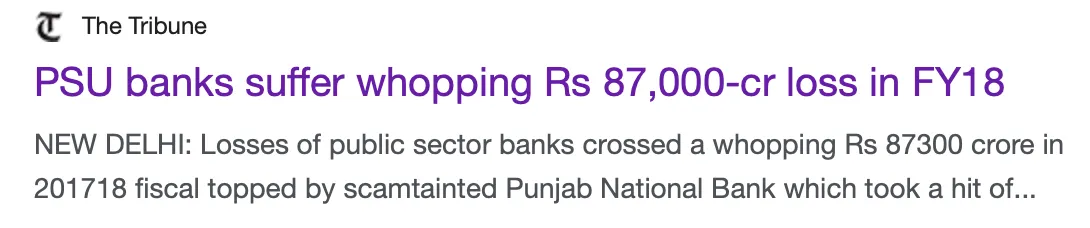
The Indian Goverment administration admitted that banking sector and specifically PSU banks were undergoing huge amount of stress
The period of 2008-14 will be remembered as a period of aggressive credit growth and, as per RBI, the primary reason for spurt in non-performing loans and stressed assets. Outstanding loans of public sector banks ballooned from ` 18 lakh crore to ` 52 lakh crore during this period. Many projects were started that could either not be completed or had low capacity utilisation resulting in their inability to pay back their loans. There were high stressed and non-performing assets (NPAs) amounting to ` 5.4 lakh crore in 2014. Many more were hidden through restructuring or otherwise which were discovered during Asset Quality Reviews and inspections carried out since 20151
To remediate the issue the government came up with Banking Reforms and Insolvency and Bankruptcy Code (IBC) which completely overhauled the bankruptcy laws in India. The IBC aimed at synthesizing and improving India’s restructuring laws in order to provide restructuring outcomes with greater certainty and efficiency thereby incentivizing further investment into the country. Prior to the IBC, India’s insolvency resolution process involved a range of legislation that had been passed over several decades. The applicable insolvency laws included the Sick Industrial Companies Act (1985), the Securitisation and Reconstruction of Financial Assets and Enforcement of Security Interest Act (2002), the Recovery of Debt Due to Banks and Financial Institutions Act (1993), and the Companies Act (2013). This collection of laws created a fragmented and, at times, contradictory bankruptcy regime in India. As a result, decisions were often appealed, stayed, or overturned, resulting in long delays in insolvency cases, with the average resolution taking four and a half years.
The IBC sought to remedy the situation by consolidating the insolvency laws under one statutory scheme2
The results are showing up on aggregate data
-
Clean up Job in Term 1
-
Stabilisation Job in Term 2
The advances are also increasing on clean up in NPA, in fact the current growth of advances has been sharper than private sector banks
PSBs have also strengthened their capital adequacy, with the capital-to-risk-weighted assets ratio improving to 15.4% in Sept 2024 from 11.5% in March 2015.3
The best metric to gauge this changes is sharp positive movement of ROA (Return on Assets) in last 5 years
On average these banks have improved ROA by 3 times
However the value destruction was so huge that most of these banks have book value below what was there book value 10 years ago
Only 3 banks State Bank of India, Indian Bank , Bank of Baroda have a higher book value than what they use to have 10 years ago. The worst performance is from Bank of India some serious value destruction
However Mr Market is giving a thumps up to this clean up and restoration work done by government the average price we are paying for these banks is twice as much as median price we have paid in past for PSU banks
Whether the current prices reflect value or not , I will leave that to your judgement.
I may or may not have position in all companies discussed above, this post is expand my knowledge on this sector.
Get something interesting to read or watch on WhatsApp daily
A lot goes in curating these analysis consider subscribing and supporting independent creators like me
I try to end post with something from gallery

Footnotes
-
https://www.indiabudget.gov.in/doc/bspeech/bs201920(I).pdf ↩
-
https://www.nortonrosefulbright.com/en/knowledge/publications/ab7ba3b7/in-midst-of-credit-crisis-india-implements-further-changes-to-bankruptcy-laws ↩
-
https://timesofindia.indiatimes.com/business/india-business/gross-npas-of-psu-banks-drop-to-3-1-from-14-6-in-18/articleshow/116269393.cms ↩
This is a record of the author's thinking in December 2024, kept as written. It is not a recommendation to buy or sell, and the author may hold the securities discussed. See the disclosures.