Cochlear Limited (ASX: COH)
On 22 April 2026, Cochlear (COH.AX) delivered one of the most savage single-day sell-offs in its 30+ years as a listed company. Shares opened down 32% and closed the session ~40% lower, wiping out more than A$4.4 billion in market value in a single trading day. A decade low and 64% below its 52-week high of $319.56.
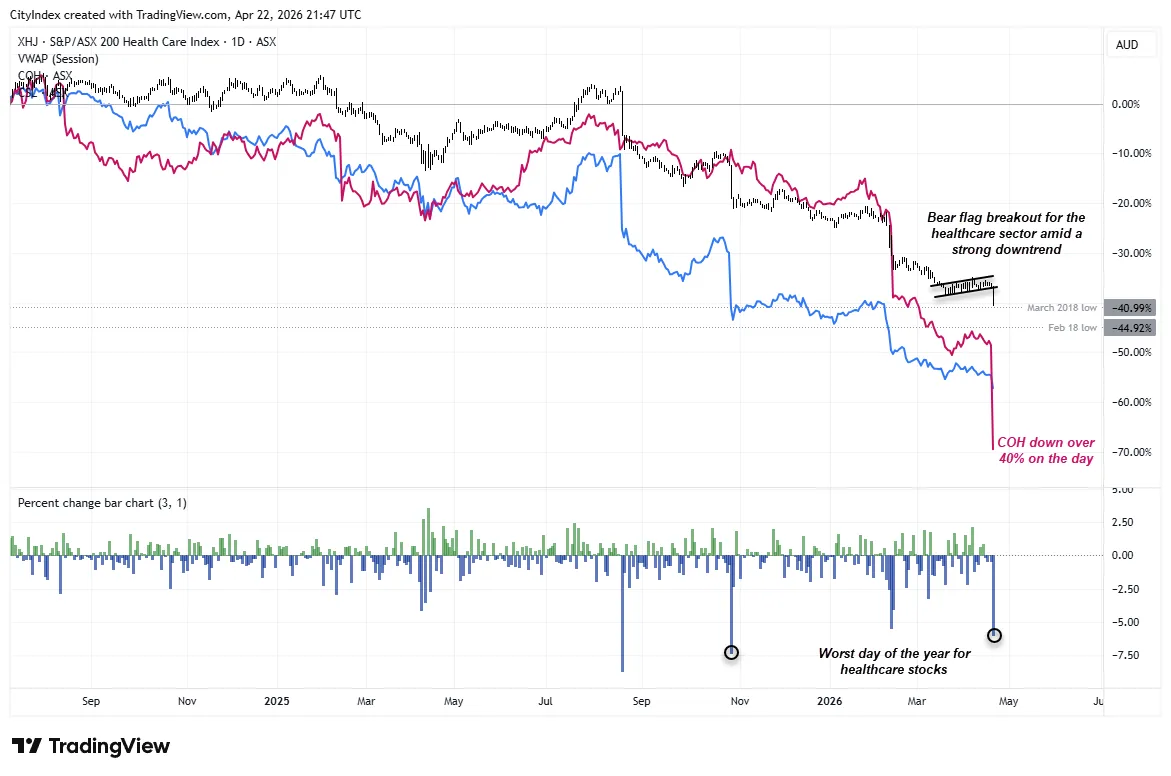
Management slashed FY26 underlying net profit guidance by ~30% at the midpoint – from A$435–460 million (issued just eight weeks earlier) to A$290–330 million. The reversal shocked the market and raised questions about execution and visibility.
Yet the core business remains intact: dominant global market share, an insurmountable technological moat strengthened by the world’s first on-device AI cochlear implant, a fortress balance sheet, and a demographic tailwind that is only accelerating. This report applies the same rigorous framework I use across all Tankrich analyses – business quality, industry vectors, moat durability, management stewardship, financial integrity, risks (via inversion), valuation scenarios, and a clear investment thesis. I will argue both sides honestly before delivering the verdict.
Part I: The Business — What Does Cochlear Actually Do?
1.1 The Irreplaceable Hearing Restoration Leader
Cochlear designs, manufactures, and sells implantable hearing solutions (cochlear implants) that bypass damaged parts of the ear to directly stimulate the auditory nerve. It also generates high-margin recurring revenue from sound processors, accessories, upgrades, and services.
1.2 The Two Core Revenue Streams
-
Implant units: One-time surgical procedures (the “razor”).
-
Services & upgrades: Recurring processor replacements, firmware updates, and consumables (the “blades”) – already growing +13% and providing earnings resilience.
Cochlear holds 50–60% global share. Its products are the gold standard for surgeons worldwide due to reliability, long-term data, and clinical outcomes.
Part II: The Industry — Four Secular Growth Vectors
2.1 Aging Populations and Rising Prevalence of Hearing Loss
Hearing loss affects over 1.5 billion people globally, projected to reach 2.5 billion by 2050. Developed markets are seeing earlier diagnosis and expanding indications (single-sided deafness, earlier paediatric implantation).
2.2 Expanding Reimbursement and Adult/Senior Penetration
Adult and senior segments (historically under-penetrated) are the biggest opportunity. Reimbursement is improving in key markets.
2.3 Technological Convergence
AI, connectivity (Bluetooth LE Audio), and firmware-upgradable implants are turning a medical device into a “smart” lifelong solution.
2.4 Emerging Market Catch-Up
Lower-price competitors exist, but Cochlear’s quality and surgeon trust give it an edge as middle-class populations in Asia and Latin America gain access.
Figure 2: Global Cochlear Implants Market Size & Growth Forecast
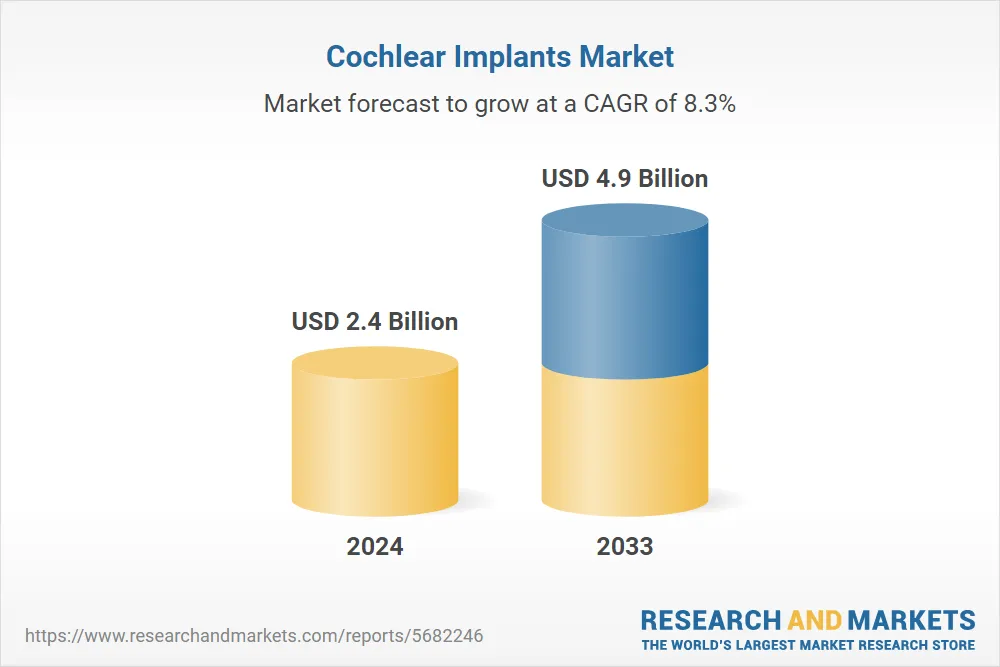
(Source: Research and Markets – Market expected to grow from ~USD 2.4B in 2024 to USD 4.9B by 2033 at 8.3% CAGR. North America dominates with ~43% share; Cochlear leads the competitive landscape.)
Part III: The Moat — Why Can’t a Competitor Do This?
3.1 Porter’s Five Forces: An Unusually Favourable Structure
-
Supplier power: Low (specialised components but multiple sources).
-
Buyer power: Moderate (hospitals/surgeons are loyal due to training and outcomes).
-
Threat of substitutes: Low (hearing aids are inferior for profound loss).
-
New entrants: Extremely high barriers (regulatory approvals, clinical data, surgeon relationships take 7–10+ years).
-
Rivalry: Concentrated but Cochlear leads on innovation and share.
3.2 Sources of Competitive Advantage
-
Technological leadership: The Nucleus® Nexa™ System (launched recently) is the world’s first smart cochlear implant with on-device machine learning (real-time environment classification via SCAN 2), internal memory for patient-specific MAPs, and upgradeable firmware – future AI improvements delivered over-the-air without surgery.
-
Surgeon lock-in and clinical data moat: Decades of proven outcomes.
-
Scale in manufacturing and services: High-margin recurring revenue.
-
Regulatory and IP barriers: Competitors (MED-EL, Advanced Bionics/Sonova, Nurotron) lag on on-implant AI. MED-EL focuses on rehab apps; Advanced Bionics on connectivity; Nurotron wins on price in emerging markets only.
Part IV: The Management — The Stewards of the Fortress
CEO Dig Howitt has led since 2018 with a steady hand through previous cycles. The 22 April update was brutally transparent – no sugar-coating the demand softness, Middle East receivable risks, production-margin impact, restructuring costs, or FX headwinds (stronger AUD).
Capital allocation has been disciplined: consistent dividends at ~70% payout, no reckless M&A, and continued R&D investment even in the downgrade. No red flags on accounting or governance. Institutions own >55% (State Street 8.3%, AustralianSuper 7.2%, BlackRock 6.6%).
Part V: The Financials
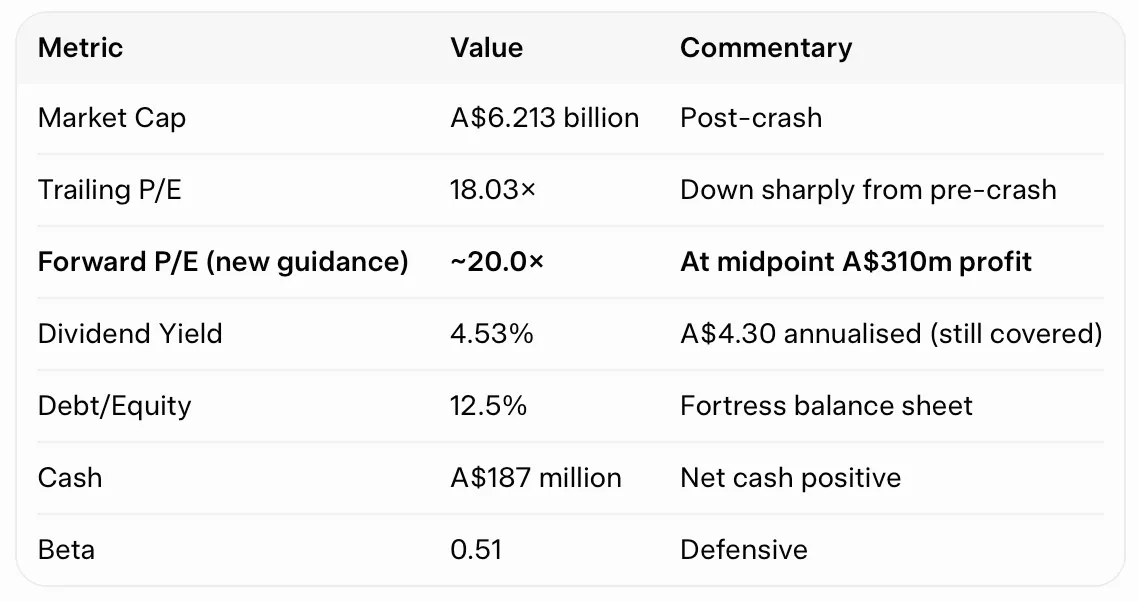
5.1 The Business Model Ratios
5.2 Revenue and Earnings Quality
Services revenue (+13%) remains resilient. The downgrade stems from softer implant unit demand in US/Europe (discretionary sentiment at historic lows), surgical capacity constraints, potential Middle East provisions, lower production overhead absorption (~1% gross margin hit), restructuring, and FX (~A$25m after-tax impact).
5.3 Accounting Quality
Clean bill of health historically. The guidance cut reflects genuine near-term visibility collapse rather than aggressive prior over-promising.
Part VI: The Risks — Invert, Always Invert
6.1 The Inversion Discipline
What could make this a permanent impairment rather than a temporary storm?
6.2 Risk 1: Prolonged Demand Softness in Developed Markets
US/Europe consumer caution on discretionary procedures could extend beyond FY26.
6.3 Risk 2: Execution on Cost Reshaping and Production
Margin pressure from lower volumes must be managed without damaging long-term innovation.
6.4 Risk 3: FX and Geopolitical Receivables
AUD strength and Middle East uncertainty are real but largely one-off or hedgeable.
6.5 Risk 4: Competition in Price-Sensitive Markets
Nurotron and others erode share where cost trumps technology.
6.6 Risk 5: Visibility and Multiple Compression
Near-term earnings uncertainty is the lowest in recent memory. A further miss could keep the multiple suppressed.
All quantified and already largely priced in at current levels.
Part VII: The Valuation — What Are We Paying and What Do We Get?
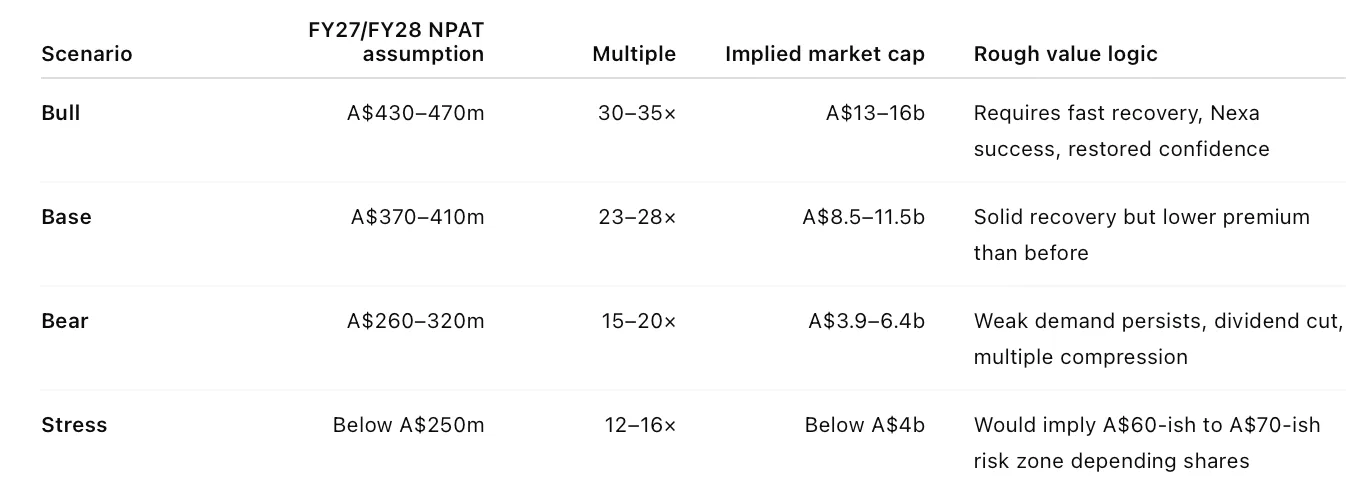
7.1 The Scenario Framework
7.2 The Munger Big-No-Brainer Test
Would I happily own this business for 10 years at today’s price if the stock never traded again? May be – demographic tailwinds + AI moat + recurring revenue + fortress balance sheet + 4.5% yield while I wait.
7.3 What the Stock Price Already Assumes
Near-zero growth and sustained margin pressure.
Part VIII: Conclusion — The Thesis in Full
8.1 What This Business Is
Cochlear is a high-quality, wide-moat medical device franchise with irreplaceable technology leadership (now supercharged by on-device AI via Nucleus Nexa), recurring revenue, and exposure to unstoppable demographic forces.
8.2 What the Numbers Say
The 40% crash has reset valuation to levels last seen a decade ago. Trailing P/E 18×, forward ~20×, 4.53% yield, debt/equity 12.5%. The business did not break; near-term visibility did.
8.3 The Key Monitoring Framework
-
H2 FY26 sales growth (target 2–6% constant currency).
-
Nexa adoption metrics and market share.
-
Services revenue trajectory.
-
Any dividend policy commentary.
-
Order book and adult/senior penetration trends.
8.4 The Final Verdict
Its a Buy but only for patient, 3–5+ year capital.
This is not a quick trade. Near-term uncertainty remains elevated, and visibility is lower than at any point in recent memory. But for portfolios seeking quality healthcare exposure with a margin of safety, the risk/reward skews heavily positive at current levels. The market has handed long-term believers a rare reset on one of Australia’s premier medical-device franchises.
Position size appropriately (reflecting the short-term risks), consider dollar-cost-averaging
This is a record of the author's thinking in April 2026, kept as written. It is not a recommendation to buy or sell, and the author may hold the securities discussed. See the disclosures.