Small Cap Funds you need to pay attention
We are running an independence special, life time access to newsletter get it here
offer will close on Monday 17th August
Bonus* I will thrown in
-
BTC course
-
GOLD course
-
Silver Trend following indicator
All of above are worth more than $1000 USD, see you inside
*Activated after 72 hours
In the 1930s, while the Golden Gate Bridge was being built, one safety decision changed the psychology of an entire construction site.
A safety net was installed under the bridge during deck construction. It saved 19 workers who fell and survived; those men later became known as the “Halfway to Hell Club.” The net did not remove the danger, but it changed how people behaved around danger. It gave workers the confidence to keep doing hard work in a high-risk environment.
Investing in small caps works in a similar way, except for one uncomfortable difference.
There is no net.
When small-cap investors fall, they feel every inch of it. The long-term numbers may look beautiful, but the path to those numbers is psychologically brutal.
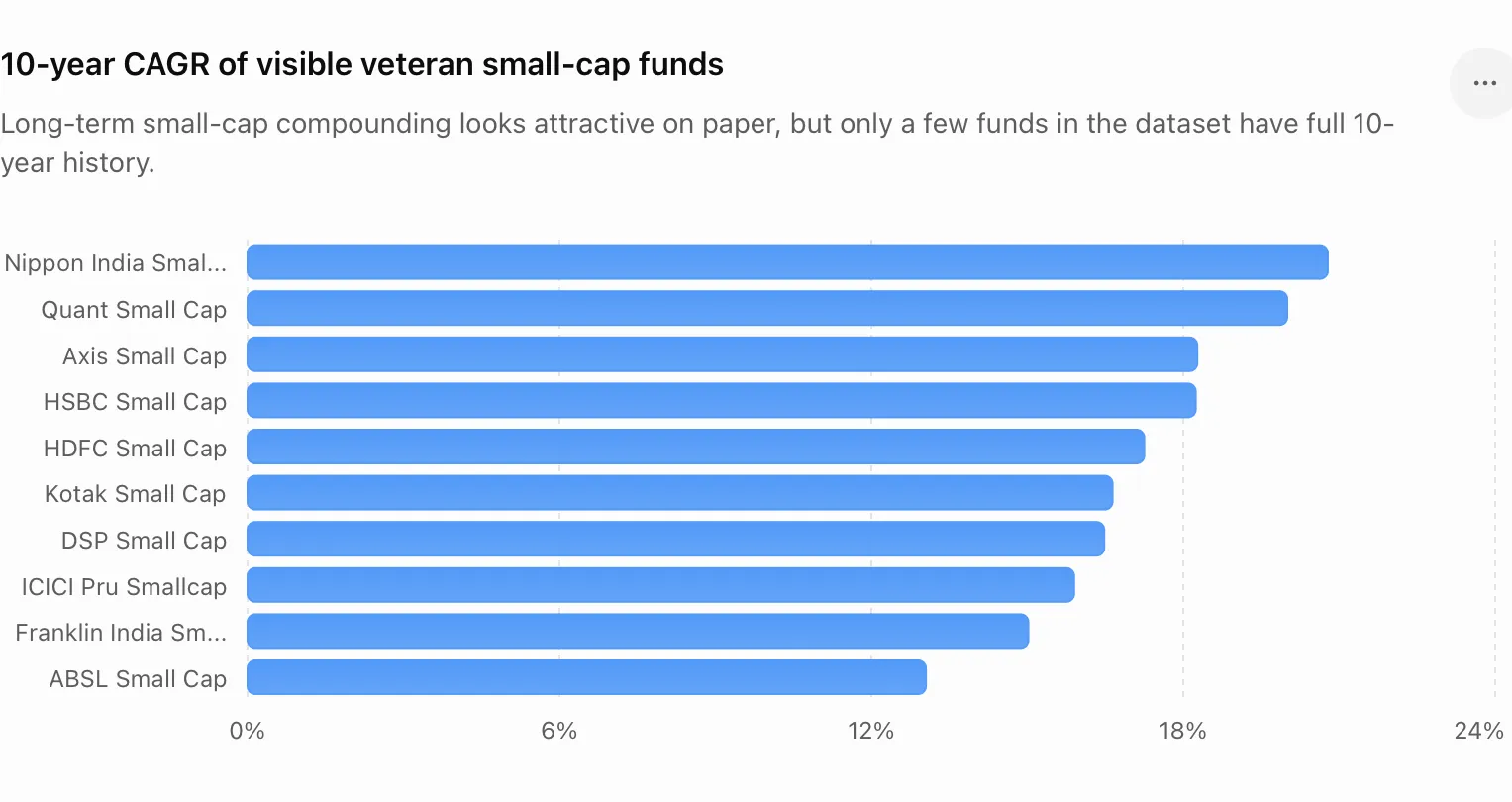
On a spreadsheet, these numbers look almost unreal.
Nippon India Small Cap shows a 20.78% 10-year CAGR. Quant Small Cap shows 20%. Axis and HSBC are both above 18%. HDFC, Kotak and DSP are all in the mid-to-high teens over a decade.
This is why small caps remain so attractive. At 17–20% annualized returns, money does not merely grow. It transforms.
But this is also where investors misunderstand the product. They see the long-term return and assume the experience will feel like the long-term return.
It never does.
The invoice arrives in the short term
The same funds that look impressive over 10 years can look ordinary, frustrating or even wrong over 1–2 years.
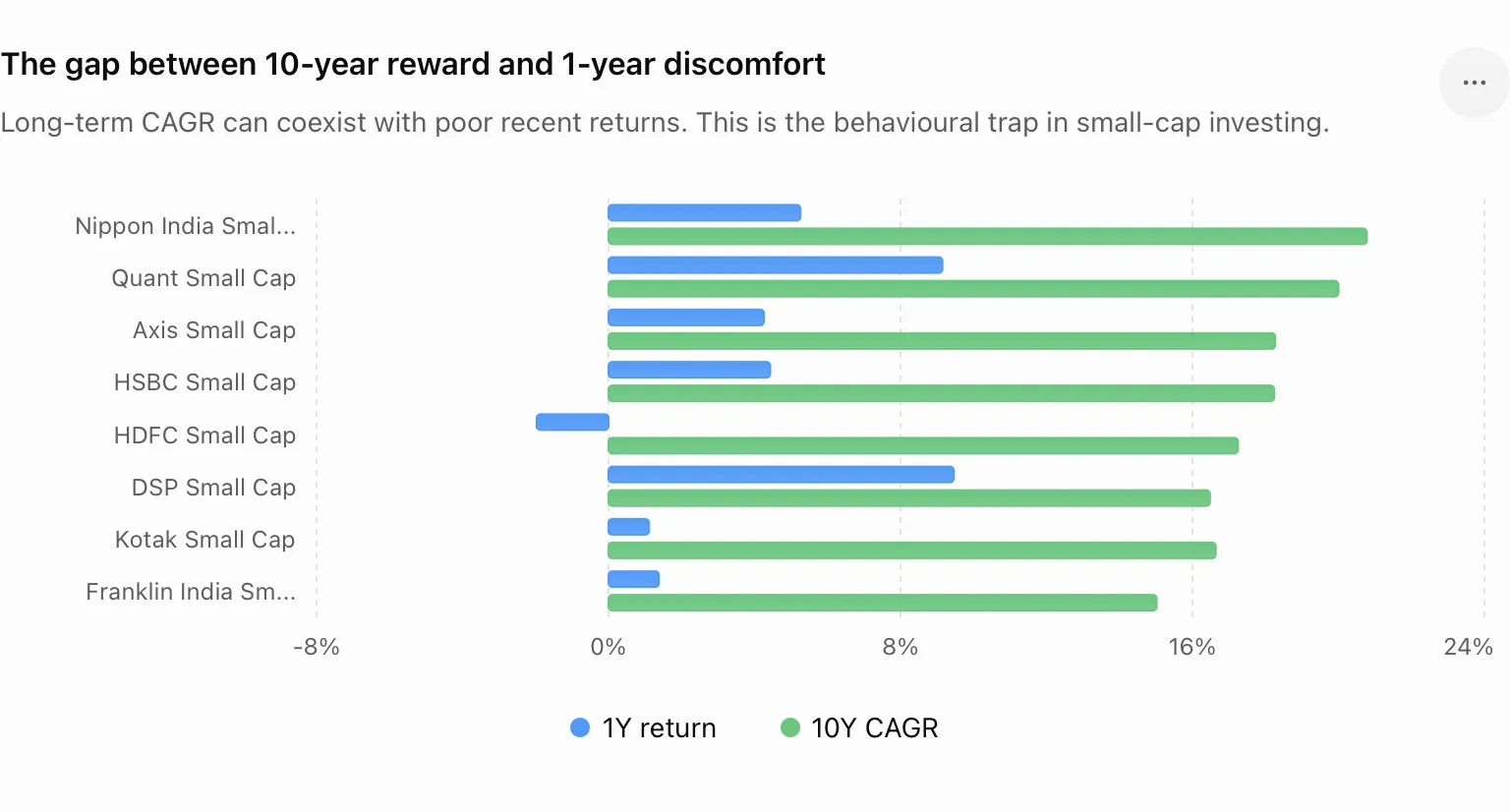
HDFC Small Cap has delivered 17.25% over 10 years, but its 1-year return in this dataset is -1.97%. Nippon has a 20.78% 10-year number, but the latest 1-year number is only 5.26%. Kotak shows 16.64% over 10 years, but only 1.11% over 1 year.
This is the emotional toll.
When you look backward at a 10-year chart, the bad periods look like tiny bumps. But when you are living through them, they feel enormous. A flat year feels like failure. A negative year feels like betrayal. A two-year period of weak returns makes investors question the fund, the manager, the category and themselves.
Small-cap investing is not mainly a return problem. It is an endurance problem.
Size itself becomes a variable
The other invisible issue is capacity.
A small-cap fund is supposed to hunt in smaller companies. But when the fund itself becomes huge, the game changes. It may still perform well, but it cannot behave like a nimble boutique fund forever.
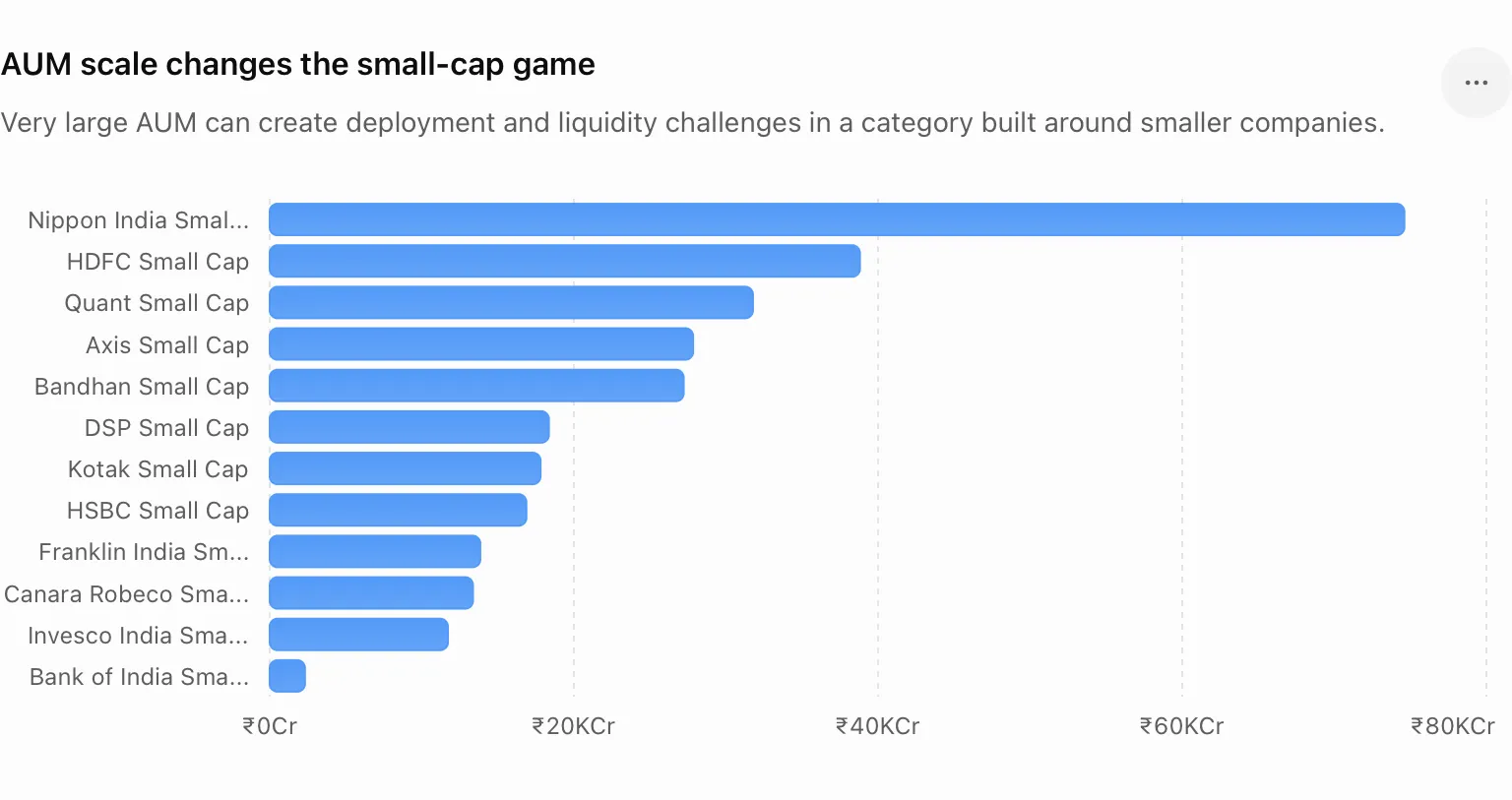
Nippon’s AUM is ₹74,604 crore. HDFC is at ₹38,809 crore. Quant is at ₹31,774 crore. Axis and Bandhan are both above ₹27,000 crore.
This does not mean these funds are bad. It means the question changes.
For a small fund, the question is: Can the manager find winners?
For a very large small-cap fund, the question is: Can the manager still find enough winners at scale without diluting the portfolio into a more mid-cap-like exposure?
That is why the most interesting research is not always in the obvious large names.
Four funds worth studying more closely
Among the visible funds in our dataset, four names deserve deeper research: Bank of India Small Cap, Invesco India Smallcap, DSP Small Cap and HSBC Small Cap.
They are interesting for different reasons.
Bank of India Small Cap: the hidden alpha candidate, but with a tenure caveat
Bank of India Small Cap is one of the most striking funds in the dataset.
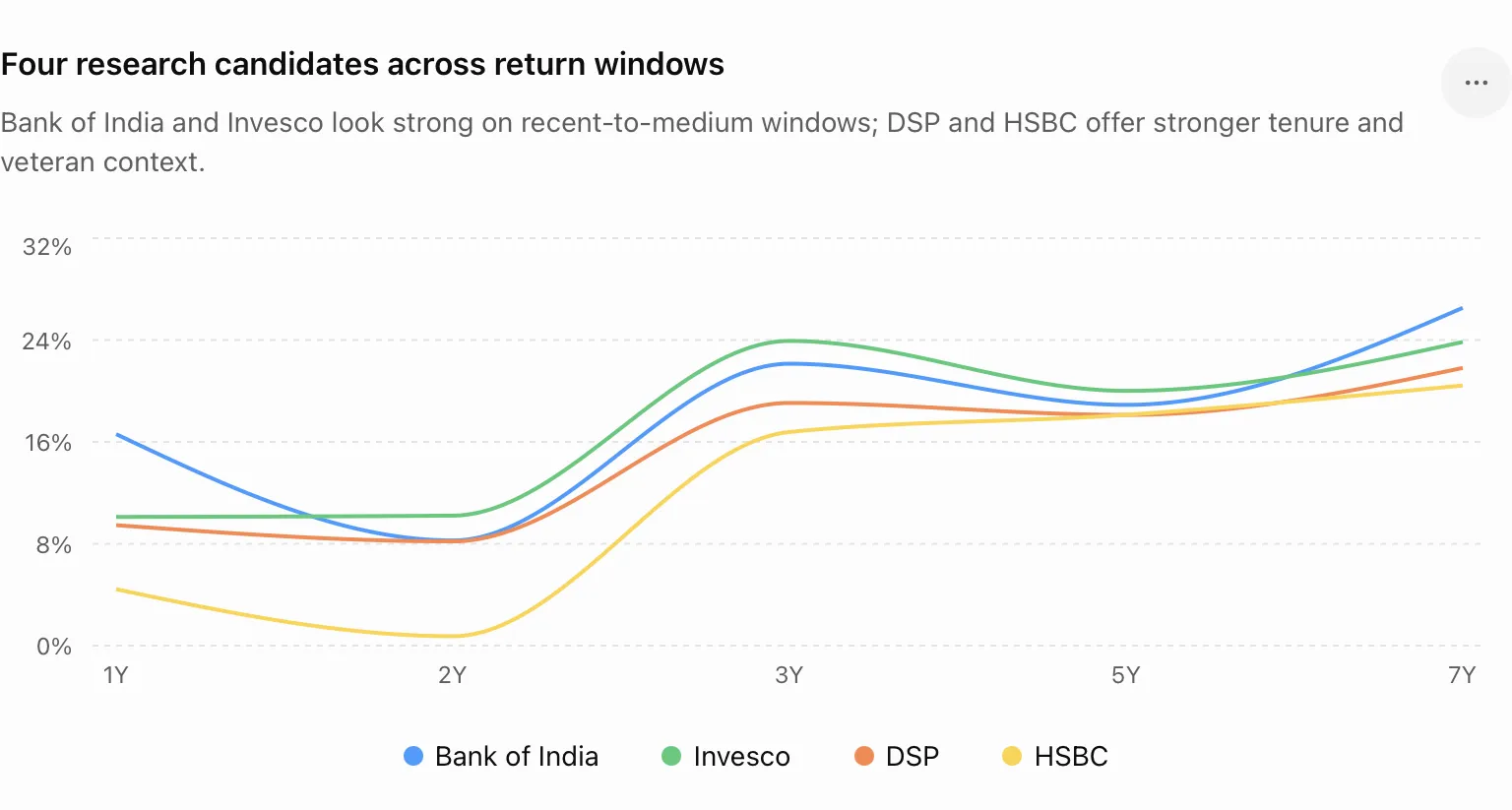
It has only ₹2,318 crore AUM, yet shows 16.61% over 1 year, 22.14% over 3 years, 18.91% over 5 years and 26.53% over 7 years.
That is a powerful profile. It also has a structural advantage: at this size, the fund may still have flexibility to buy smaller opportunities that giant funds cannot meaningfully own.
But there is an important caveat. The official Bank of India Mutual Fund page says Alok Singh has managed the scheme from 1 October 2024, and Nav Bhardwaj has co-managed it from 14 July 2025. That means the strong 5-year and 7-year returns cannot be attributed entirely to the current named manager setup.
Bank of India Small Cap is a hidden data standout, but its historical returns must be separated from current manager-tenure evidence.
That makes it a strong research candidate, not an automatic conclusion.
Invesco India Smallcap: the cleanest all-round profile
Invesco is the most balanced fund in this shortlist.
It shows 10.11% over 1 year, 10.21% over 2 years, 23.93% over 3 years, 20.01% over 5 years and 23.85% over 7 years. There is no obvious collapse in the recent numbers.
That consistency matters.
The fund is also large enough to prove acceptance, but not so large that capacity becomes the first concern. At ₹11,717 crore AUM, it sits in a useful middle zone.
Invesco’s official one-pager says Taher Badshah has managed the fund since 30 October 2018, while Aditya Khemani has managed it since 9 November 2023. The same document says the fund follows a bottom-up approach, uses a proprietary stock-categorisation framework, has a bias for growth stocks, is largely fully invested, and typically holds around 55–75 stocks
This is why Invesco stands out - combination of returns, reasonable scale, identifiable process and meaningful manager continuity.
DSP Small Cap: the continuity story
DSP is not the flashiest return profile here, but it has something many funds do not: manager continuity.
DSP’s official page says Vinit Sambre has managed DSP Small Cap Fund since June 2010. That is a rare tenure in small caps. The same page notes that the fund invests in emerging companies and warns investors that small-cap NAVs can fluctuate heavily; DSP even discloses that the fund has previously seen a 60% fall in NAV over one year.
hat warning is valuable. It tells investors the truth about the product.
DSP’s return profile is not the highest in the table, but it is respectable: 9.46% over 1 year, 19.06% over 3 years, 18.12% over 5 years, 21.81% over 7 years and 16.48% over 10 years.
DSP may not be the fund that excites performance chasers. But for investors who value process, discipline and manager tenure, it deserves attention.
HSBC Small Cap: the underappreciated style-lag candidate
HSBC is the most nuanced of the four.
Its long-term numbers are good: 18.13% over 5 years, 20.43% over 7 years and 18.24% over 10 years. But the recent numbers are weak: 4.43% over 1 year and only 0.74% over 2 years.
This is not automatically a red flag. It may be a style issue.
HSBC’s one-pager describes the fund as bottom-up and focused on smaller companies gaining market share, niche businesses, and businesses with long growth opportunity. It also says the fund aims to invest in undervalued, under-owned and under-researched segments. The same document lists Venugopal Manghat effective 17 December 2019 and Mayank Chaturvedi effective 1 October 2025, with Mayank handling foreign securities wherever applicable.
This makes HSBC interesting for a different reason.
It is not a momentum pick. It is a possible style-reversion candidate. The fund has a respectable long-term record, but recent returns suggest its current portfolio style has not been in favour.
The real lesson
Most investors ask: Which fund gave the highest return?
That is the wrong first question.
A better question is:
What kind of pain did the fund ask investors to endure, and was the return generated under a manager and process that still exist today?
Bank of India shows hidden alpha, but manager-tenure attribution needs care.
Invesco shows the cleanest balance of performance, size and process.
DSP shows the strongest continuity story.
HSBC shows that a good long-term record can hide a painful recent cycle.
The uncommon conclusion is this:
Small-cap wealth is not created by by selecting a fund whose volatility, manager style, capacity profile and behavioural cost you can actually survive. We do this for a living at Tankrich MFD
There is no safety net in small caps.
The only substitute is process, patience and self-knowledge.